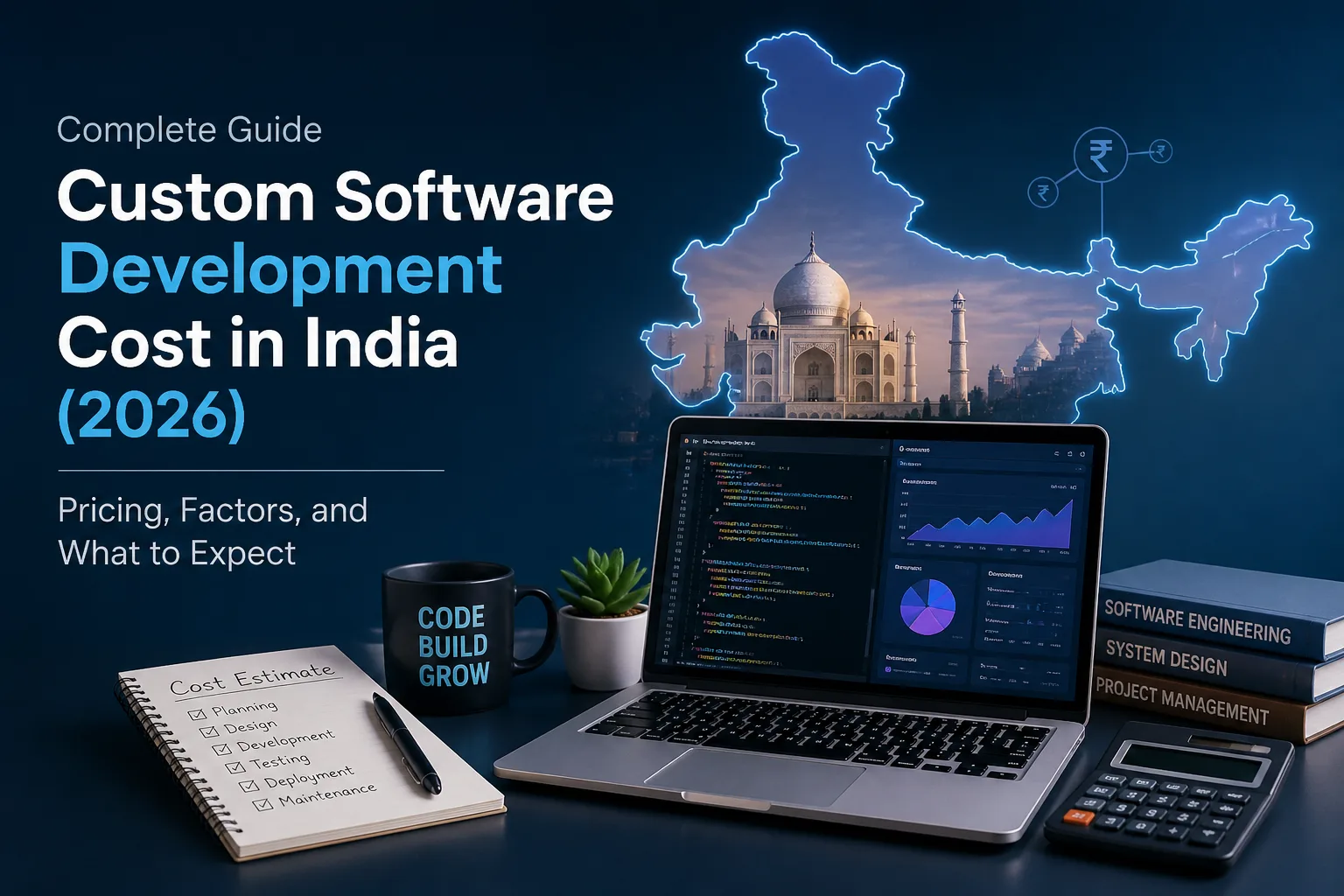
Custom software development cost in India in 2026 ranges from $15,000 for an MVP to $500,000+ for enterprise platforms. India saves 50-70% versus US/UK rates, with senior developer hourly rates of $20-$60/hr versus $120-$200/hr in the US. Real numbers below from 250+ shipped projects.
Quick Answer: How Much Does Custom Software Cost in India in 2026?
Custom software development in India costs $15,000 to $50,000 for an MVP, $50,000 to $150,000 for a mid-complexity product, and $150,000 to $500,000+ for enterprise platforms. India delivers the same product at 50-70% lower cost than the US or UK, with senior engineer rates of $20-$60 per hour versus $120-$200 per hour in the US.
Table of Contents
- Custom Software Cost By Project Tier (2026)
- Hourly Rates in India vs Other Regions
- Cost By Software Type — Real Datasoft Ranges
- The 5 Biggest Cost Drivers Explained
- Hidden Costs That Wreck Budgets
- Why Some Quotes Look Impossibly Cheap
- Fixed-Price vs Time-and-Materials vs Dedicated Team
- How to Save 30-40% Without Sacrificing Quality
- How to Estimate Your Project Cost (Self-Assessment)
- Custom Software Cost FAQs
If you've ever asked a software development company "what will this cost?", you've probably heard "it depends on the requirements." That answer is technically true and practically useless.
This guide is the opposite. We've shipped over 250 software projects across India, the United States, the United Kingdom, Singapore, and Australia since 2014 — for SME founders, US/UK startups, and enterprise buyers. Every number below comes from real projects, real quotes, and real client conversations in 2026.
If you're an Indian SME owner budgeting your first custom system, a US/UK founder evaluating offshore development options, or a procurement head comparing vendor proposals — this is what you actually need to know.
Custom Software Cost By Project Tier (2026)
Here are the four tiers we see across real client projects in 2026, with the actual ranges we ship within.
Tier 1: MVP — $15,000 to $50,000
An 8 to 14-week build with 2-3 engineers, single platform (web or mobile, not both), one to two integrations like Stripe or Razorpay, basic admin panel, and standard authentication. This is what serious founders need to validate a market with paying users — not a clickable prototype, but not over-engineered either. Most startup MVPs we ship land in the $25K-$45K range.
Tier 2: Mid-Complexity Product — $50,000 to $150,000
A 3 to 6-month build with 4-6 engineers, multi-platform (web + mobile), multi-tenant architecture, four to eight integrations, and a role-based admin panel. This is where most growing SaaS products and SME business platforms sit. It's also the most common tier we work in.
Tier 3: Enterprise — $150,000 to $500,000
A 6 to 12-month build with 6-12 engineers, web + iOS + Android, HIPAA/SOC2/GDPR compliance baked in from day one, SSO and enterprise integrations, AI/ML features where they genuinely add value. This tier is for serious B2B platforms, regulated industries, and enterprise-internal systems.
Tier 4: Platform — $500,000+
A 12+ month build with 12+ engineers, multi-region deployment, multi-product architecture, dedicated security team, SLA-backed uptime guarantees. Realistically only relevant for venture-funded platforms or critical enterprise systems at scale.
Get a tailored estimate for your specific project in 60 seconds using our free Custom Software Cost Calculator — based on real numbers from 250+ shipped projects.
Hourly Rates by Region: The Single Biggest Lever on Total Cost
Region is the single biggest variable affecting your total project cost. Here's the honest 2026 picture for senior software engineer hourly rates and what an MVP typically costs in each region.
| India | $20-$60/hr | $15K-$45K | −60% to −70% |
| Eastern Europe | $40-$80/hr | $30K-$70K | −40% to −55% |
| Latin America | $50-$90/hr | $40K-$80K | −30% to −50% |
| United Kingdom | £80-£140/hr | £60K-£140K | ~baseline |
| United States | $120-$200/hr | $80K-$180K | baseline |
| Australia | A$130-A$200/hr | A$90K-A$180K | ~baseline |
Why India Is Cheaper (And Why Quality Doesn't Have to Suffer)
India offers software development at 50-70% lower cost than the US for four real reasons: lower cost of living, abundant engineering talent (1.5 million engineers graduate annually), favorable currency exchange, and decades of mature outsourcing infrastructure. Quality at top-tier Indian agencies is comparable to US/UK work — the savings come from labor cost differences, not corner-cutting.
India's real positioning in 2026: roughly 4-6x cheaper than US and Western Europe, 1.5-2x cheaper than Eastern Europe, similar pricing to Vietnam and the Philippines but with deeper engineering depth, English fluency, and a stronger documentation culture.
The honest trade-offs:
- Strengths: Massive talent pool, comfortable working with US/UK/EU clients, time-zone overlap with Europe and APAC, mature processes at top agencies
- Real challenges: Time-zone gap with the US (managed by good agencies via overlap hours), and significant variability in agency quality — the bottom 60% of Indian agencies are genuinely poor. Picking the right Indian partner matters more than picking India over another country.
Custom Software Cost by Type: Real Datasoft Build Ranges
Different software types have very different cost profiles. Here are actual MVP and full-build ranges we quote across categories we work in most.
| Software Type | ||
| Custom SaaS | $15K-$50K | $50K-$200K+ |
| HRMS Platform | $18K-$45K | $45K-$150K+ |
| Gym & Fitness SaaS | $20K-$45K | $50K-$120K |
| B2B Travel Portal | $25K-$55K | $60K-$150K+ |
| Business Management System | $15K-$40K | $40K-$120K |
| SOS & Safety App | $15K-$30K | $35K-$90K |
| Mobile App (iOS + Android) | $20K-$60K | $60K-$180K+ |
| AI / Generative AI App | $25K-$70K | $70K-$250K+ |
| Custom ERP | $25K-$60K | $60K-$200K+ |
| E-commerce Platform | $20K-$50K | $50K-$180K+ |
A few honest notes on these ranges:
SaaS and HRMS platforms are where we have the deepest experience. We've built and run our own SaaS products including Paylap Fitness, Paylap HRM, and Paylap Pet Care. Building your own SaaS is genuinely different from building someone else's — agencies that haven't shipped their own products often underestimate where time and cost hide.
AI projects have the widest cost range in 2026 because "AI" means anything from "we wrapped OpenAI's API" to "we built a custom ML pipeline with proprietary training data." Always ask exactly what's being built. A $5K "AI app" using off-the-shelf APIs is a different product than a $70K custom AI build, and both can be the right answer depending on your needs.
Mobile apps requiring iOS + Android can be 2-3x the cost of single-platform if built natively. Cross-platform frameworks like React Native or Flutter recover 30-40% of that overhead — see our detailed React Native vs Flutter comparison.
For ERP-specific costs in manufacturing, particularly auto-component plants in India, see our deep-dive: ERP for Auto Component Manufacturers in India: A Practical 2026 Guide.
The 5 Biggest Cost Drivers in Custom Software Development
1. Scope and Feature Count
Every additional feature adds linear cost. Cutting from 30 features to 15 typically halves the build cost. The single biggest cost reducer in custom software is ruthlessly cutting scope for v1 and adding the rest in v2 once you have real user feedback.
2. Team Region
As shown in the rates table above, the same product built in the US can cost 4-5x what it costs in India. Region matters more than seniority — a senior Indian engineer at $40-60/hr typically delivers work comparable to a $150/hr senior US engineer.
3. Third-Party Integrations
Each integration adds 1-4 weeks of engineering time. Salesforce, HubSpot, NetSuite, and bespoke ERP integrations are typically the most expensive because of their complexity and quirks. Standard integrations (Stripe, Razorpay, Twilio, SendGrid) are faster and well-documented, often adding less than a week.
4. Compliance Requirements
HIPAA, SOC2, GDPR, PCI-DSS, or India's DPDP Act add 15-35% to total cost. The expensive part isn't writing compliant code — it's audits, documentation, ongoing controls, and architectural decisions compliance forces. Always start from day one rather than retrofitting; retrofit costs are 3-5x higher.
5. Platform Coverage
Web + iOS + Android can be 2-3× the cost of one platform. Cross-platform frameworks (React Native, Flutter) recover 30-40% of that overhead, which is why most modern startups choose cross-platform unless they have a specific reason for native (heavy graphics, AR/VR, deep OS integration).
Bonus factor — Design polish. Pixel-perfect, branded design with custom motion adds 10-25%. For most products, you can ship v1 with a clean design system and add the polish later. Don't optimize for design awards before validating product-market fit.
Hidden Costs That Wreck Software Budgets
The development quote is rarely the full cost. Here's what gets left out of most proposals — and what you should explicitly ask about before signing any contract.
Discovery and design phase. Good projects start with 3-6 weeks of process discovery, wireframing, and UX design before any code is written. This costs 8-15% of total budget. Quotes that skip this set up projects that hit painful rework in months 3-4.
Third-party services and licenses. Cloud hosting ($200 to $2,500/month depending on scale), payment gateways (2-3% per transaction), SMS/email/push notification services, maps APIs (Google Maps Platform can hit $400-1,000/month at scale), and analytics tools. Budget $500 to $3,500/month in third-party tooling for a typical SaaS.
Hosting and infrastructure setup. AWS, GCP, or Azure setup with proper environments (dev, staging, production), CI/CD pipelines, monitoring, backups: $2,000-$8,000 one-time + $200-$2,500/month ongoing.
Security audits and penetration testing. Mandatory for fintech and healthtech, increasingly expected by enterprise B2B clients: $2,000-$10,000 per major audit cycle.
App store fees. Apple Developer Account ($99/year), Google Play Console (one-time $25), plus agency time spent navigating review rejections (which happen more often than you'd expect).
Bug fixes after launch. Real users find real bugs your QA didn't. Budget 15-20% of original development cost for the first 6 months post-launch.
Maintenance and minor enhancements. Realistic ongoing cost: 10-18% of original development cost per year. Below this, you're under-investing and the system will degrade.
Major version upgrades. Every 2-3 years, frameworks become outdated, dependencies need migration, security patches require structural changes. Budget 20-30% of original cost every 24-36 months.
Total cost of ownership in year 1 typically lands at 1.4-1.8x the initial development cost once you factor in hosting, third-party services, post-launch fixes, and minor enhancements. Plan for that, not just the development quote.
Why Some Quotes Look Impossibly Cheap (And What's Actually Happening)
If you're getting quotes ranging from $3K to $40K for the same project, you're not crazy — you're seeing the full quality spectrum of the Indian software market. Here's what's behind the suspiciously cheap end.
Junior-only teams. Three 1-year-experience developers cost the agency very little to staff. They can quote $4K for a 3-month project and still profit. The result: code written by people who've never shipped to production, no senior oversight, no proper architecture decisions, painful technical debt that surfaces in month 8.
Bait-and-switch staffing. Senior developers shown in the sales pitch never actually work on the project. You get juniors with senior names on email signatures.
Skipped phases. No discovery, no design, no QA, no documentation, no deployment automation. The "$3K app" quote is real — but it's the cost of just the coding phase, not a finished, deployable, maintainable product.
Re-outsourcing. Some "Indian agencies" are actually 2-3 person sales teams that re-outsource the work to cheaper subcontractors in tier-3 cities or other countries. You don't know who's actually writing your code.
Template farming. They start from a pirated or repurposed template and rebrand it. Works for marketing sites; disastrous for anything with real business logic.
Hidden change-order economics. The initial quote is artificially low to win the contract. Every minor change becomes a paid change order, and by month 6 you've paid 3x the original quote.
The 5-Question Test for Any Software Vendor
Ask any vendor these five questions before signing:
- Can I see the GitHub repos of three production projects you've built?
- Can I talk to the technical lead — not just the salesperson?
- Will you share resumes of the specific engineers who'll work on my project, not "people like these"?
- Will you give me a written, fixed-scope quote with assumptions and exclusions clearly listed?
- If I want to leave you mid-project — who owns the code, and how is handover documented?
Vendors who answer these crisply are usually the ones who deliver. The rest will deflect.
Fixed-Price vs Time-and-Materials vs Dedicated Team
There's a reason agencies offer different engagement models — each shifts risk between you and the agency.
Fixed-Price
Best for: Small to mid-size projects with clear, stable requirements Cost positioning: Most expensive per hour (20-35% risk padding) but most predictable for cash flow Risk to you: Scope changes are billed extra
Time-and-Materials (T&M)
Best for: Projects with evolving scope or unclear initial requirements Cost positioning: Typically 15-25% cheaper than fixed-price for the same end product Risk to you: Budget overruns if not managed actively
Dedicated Team (Staff Augmentation)
Best for: Long-running products and ongoing engineering needs Cost positioning: Cheapest per hour ($1,500-$5,000/month per engineer in India) Risk to you: Management overhead — you must direct the team week-to-week
Our honest recommendation: Most clients save the most by using fixed-price for v1 (predictable spend, well-defined scope) followed by time-and-materials for v2 onwards (flexibility as the product evolves with real user feedback). Dedicated teams make sense once you have a product manager in-house and need 12+ months of continuous engineering.
How to Save 30-40% on Custom Software Without Sacrificing Quality
There are honest ways to reduce cost. There are also ways that look cheap and aren't.
What Actually Works
- Cut features ruthlessly for v1. The single biggest cost reducer. Most MVPs have 30-50% more features than they need to validate the core idea.
- Use proven libraries instead of custom-building everything. Don't build your own auth (use Auth0/Firebase), payment processor (use Razorpay/Stripe), or search infrastructure (use Algolia/Elasticsearch).
- Choose web-first or mobile-first instead of both at launch. Cuts 35-50% by launching one platform first.
- Use no-code or low-code for admin panels. Retool, Appsmith, or similar can replace $7K-$18K of custom admin development.
- Phase your launch. Go live with core features in month 4, add the rest over months 5-8. Faster feedback, lower cost, lower risk.
- Negotiate fixed-price for v1, T&M for v2. Predictable spend upfront, flexibility later.
- Choose India over US/UK. Saves 50-70% on the same end product.
- Lock scope before development starts. Every mid-project change costs 3-5x what it would cost during planning.
What Looks Cheap But Isn't
- Going with the lowest bidder. The cost of switching agencies mid-project is enormous — legally, technically, emotionally.
- Skipping discovery. Saves $3K upfront, costs $20K in rework later.
- Skipping QA. Saves a few thousand in development, costs you customer trust on day 1 of launch.
- Choosing offshore-only with no in-house product owner. You need someone on your side who can review work, define scope, and make decisions weekly. Without that, the project drifts.
How to Estimate Your Project Cost (Self-Assessment Framework)
For a rough self-estimate before talking to vendors, follow this 4-step framework.
Step 1: List Your Features
Write out every screen, workflow, and integration you can think of. A typical SaaS has 25-60 distinct features in v1.
Step 2: Categorize Each Feature
- Simple (CRUD form, list view, basic filter): 16-32 hours
- Medium (multi-step workflow, dashboard, export): 32-80 hours
- Complex (real-time, payments, ML, video, multi-tenant logic): 80-200 hours
Step 3: Add the Multipliers
- Mobile apps (per platform): + 60-80% on top of web hours
- Admin panel: + 25-35% on top of user-facing hours
- Design / UX: + 15-25% on top of dev hours
- QA and testing: + 20-30% on top of dev hours
- Project management and discovery: + 15-20% on top of total
Step 4: Multiply by Hourly Rate
$25/hr blended (mid-tier Indian agency) is a reasonable planning rate.
Worked Example
A SaaS with 35 features split as 20 simple + 12 medium + 3 complex:
- (20 × 24) + (12 × 56) + (3 × 140) = 480 + 672 + 420 = 1,572 hours of dev work
- Add mobile (60%) + admin (25%) + design (20%) + QA (25%) + PM (15%) = roughly +145% overhead
- Total: ~3,850 hours
- At $25/hr blended = ~$96,000 total
That's a realistic ballpark for a serious SaaS MVP with web + mobile + admin in India. It won't give you a perfect quote — but it'll tell you whether the quotes you're receiving are in the right universe.
For a faster, more precise estimate based on your actual project specs, use our free Custom Software Cost Calculator.
Custom Software Development Cost FAQs
How much does custom software development cost in India in 2026?
Custom software development in India in 2026 costs $15,000 to $50,000 for an MVP, $50,000 to $150,000 for a mid-complexity product, and $150,000 to $500,000+ for an enterprise platform with compliance and integrations. Working with an India-based partner saves 50-70% versus US/UK rates without sacrificing engineering quality.
What is the hourly rate for software developers in India?
Senior software developers in India charge $20-$60 per hour in 2026, compared to $120-$200/hr in the US, £80-£140/hr in the UK, and $40-$80/hr in Eastern Europe. Junior Indian developers cost $10-$25/hr, mid-level $20-$40/hr, and specialist roles like AI/ML engineers $30-$80/hr. A typical mid-tier Indian agency quotes a blended rate of $20-$35/hr.
How long does it take to build custom software in India?
An MVP typically takes 8-14 weeks with 2-3 engineers. A mid-complexity product takes 3-6 months with 4-6 engineers. An enterprise platform takes 6-12 months with 6-12 engineers. Multi-region or regulated platforms take 12+ months with 12+ engineers.
Why is custom software cheaper in India than the US?
India offers software development at 50-70% lower cost than the US due to lower cost of living, abundant engineering talent (1.5 million engineers graduate annually), favorable currency exchange, and mature outsourcing infrastructure. Quality at top-tier Indian agencies is comparable to US/UK work — savings come from labor cost differences, not quality compromises.
What is included in custom software development cost?
Custom software cost typically includes discovery and design (8-15% of budget), development, QA testing (20-30% of dev hours), project management (15-20%), and basic deployment. Not typically included: cloud hosting ($200-$2,500/month), third-party services, security audits ($2,000-$10,000), app store fees, post-launch bug fixes, and ongoing maintenance.
Is fixed-price or time-and-materials cheaper for software development?
Time-and-materials is typically 15-25% cheaper than fixed-price for the same end product, because fixed-price contracts include 20-35% risk padding. However, fixed-price is more predictable for cash flow. Most clients save the most by using fixed-price for v1 and time-and-materials for v2 onwards.
How much does a SaaS MVP cost to build in India?
A SaaS MVP costs $15,000-$50,000 in India in 2026, built in 8-14 weeks by 2-3 engineers. A full SaaS product with web + mobile + admin + integrations costs $50,000-$200,000+. Cost depends on number of features, integrations, multi-tenancy, and platform coverage.
What is the cost of building a mobile app in India?
A mobile app (iOS + Android) costs $20,000-$60,000 for an MVP and $60,000-$180,000+ for a full build in India in 2026. Cross-platform frameworks like React Native or Flutter recover 30-40% of the cost versus native development for both platforms.
How can I estimate my software development project cost?
Use our free Custom Software Cost Calculator to get a tailored estimate in 60 seconds based on your scope, complexity, region, platform coverage, and feature requirements. For a detailed PDF estimate with phase-by-phase breakdown, share your scope and we'll send it within 48 hours.
What are the hidden costs in custom software development?
Hidden costs typically include: discovery and design (8-15% of budget), cloud hosting ($200-$2,500/month), third-party services ($500-$3,500/month), security audits ($2,000-$10,000), post-launch bug fixes (15-20% of dev cost in first 6 months), and ongoing maintenance (10-18% of dev cost annually). Total cost of ownership in year 1 typically lands at 1.4-1.8x the initial development cost.
Bottom Line for the Buyer
Custom software in India in 2026 is genuinely good value when built by the right partner. Realistic budgets at a glance:
- Focused MVP: $15K-$50K
- Mid-complexity product (web + mobile): $50K-$150K
- Enterprise platform with compliance & integrations: $150K-$500K
- Multi-region or regulated platform: $500K+
Total cost of ownership in year 1 typically lands at 1.4-1.8x initial development cost.
The cheapest quote is almost never the cheapest project. The most expensive isn't always the best work. The agencies in the middle — the ones who can clearly explain their hourly rates, team composition, assumptions, and what's not included — are usually where the real value sits.
Get Your Custom Software Cost Estimate
Three ways to get a real estimate for your specific project:
Option 1 — Instant Ballpark (60 seconds) Use our free Custom Software Cost Calculator — pulls from real numbers across 250+ shipped projects.
Option 2 — Detailed PDF Estimate (within 48 hours) Share your scope and we'll send a phase-by-phase breakdown with team composition, tech stack recommendations, risks, and ways to reduce cost.
Option 3 — Free 30-Minute Consultation A no-pitch call where we'll honestly tell you whether to build custom, use off-the-shelf SaaS, or refine your scope before spending.
About Datasoft Technologies
Since 2014, we've shipped 250+ custom software projects across India, the US, UK, Singapore, and Australia — from focused MVPs to enterprise platforms. We've also built and run our own SaaS products including Paylap Fitness, Paylap HRM, and Paylap Pet Care. Headquartered in Delhi NCR, India with EU operations in Dublin.
Related Reading
- ERP for Auto Component Manufacturers in India: A Practical 2026 Guide
- React Native vs Flutter: Cost & Performance Comparison
- Custom Software vs SaaS: Which Should You Choose?