If you run an auto-component plant in NCR, Pune, Chennai, or the Coimbatore belt — and you're still juggling production planning in Excel, dispatch in WhatsApp, and OEM schedules in printed sheets — you already know your factory has outgrown the systems running it.
This guide is for you. Not a generic "what is ERP" article. We've worked with manufacturers in the NCR auto cluster for over a decade — companies supplying to Bosch, Escorts, JBM, Imperial Auto, and similar OEMs — and the same five problems show up in nearly every plant we walk into. This article covers what an auto-component ERP actually needs to do, what it should cost in 2026, and where Indian manufacturers are wasting money buying the wrong thing.
Why generic ERP doesn't work for auto-component plants
Most ERP vendors will happily sell you a "manufacturing ERP." But auto-component manufacturing is a specific beast — and a generic SAP Business One or Tally Prime install will leave you with the same problems you started with, just in a more expensive interface.
Here's what makes auto-component manufacturing different:
OEM-driven scheduling. Your production schedule isn't yours. Maruti, Tata, Mahindra, Hero, or your tier-1 customer drops a JIT delivery schedule on you weekly (sometimes daily) and you're penalized for missed dispatches. Your ERP needs to ingest customer schedules — often via portals, Excel, or EDI — and back-calculate production, raw material, and machine loading automatically.
Multi-level BOMs with rejects and rework. A single forging or stamped part can have 8–12 operations across machining, heat treatment, plating, and inspection. Your ERP has to track WIP, scrap, and rework at each operation — not just at finished-goods level. Most off-the-shelf ERPs are weak here.
Traceability for IATF 16949 and PPAP. OEM audits will ask you for batch traceability — which raw material lot went into which finished part, which operator ran which machine that shift, which inspection report covers that batch. If your ERP can't pull that report in 30 seconds during an audit, you have an ERP problem.
Tooling, dies, and fixtures. Your tools have lives, maintenance schedules, and depreciation that doesn't fit the standard fixed-asset module. A press-tool change-over costs you four hours of production. Your ERP needs to plan around it.
Customer-specific packaging and ASN. Returnable bins, kanban cards, ASN (Advanced Shipment Notice) labels, customer-specific GRN formats — every OEM has its own dispatch protocol. A plant supplying to five OEMs is dealing with five different label formats and five different dispatch portals.
If your ERP doesn't natively handle these five things, you'll end up with three Excel sheets running parallel to your "ERP" — which is exactly where most plants are today.
The 8 modules an auto-component ERP actually needs
Here's the real module list — not the marketing one. If your ERP vendor can't demo all eight working together with auto-component sample data, walk away.
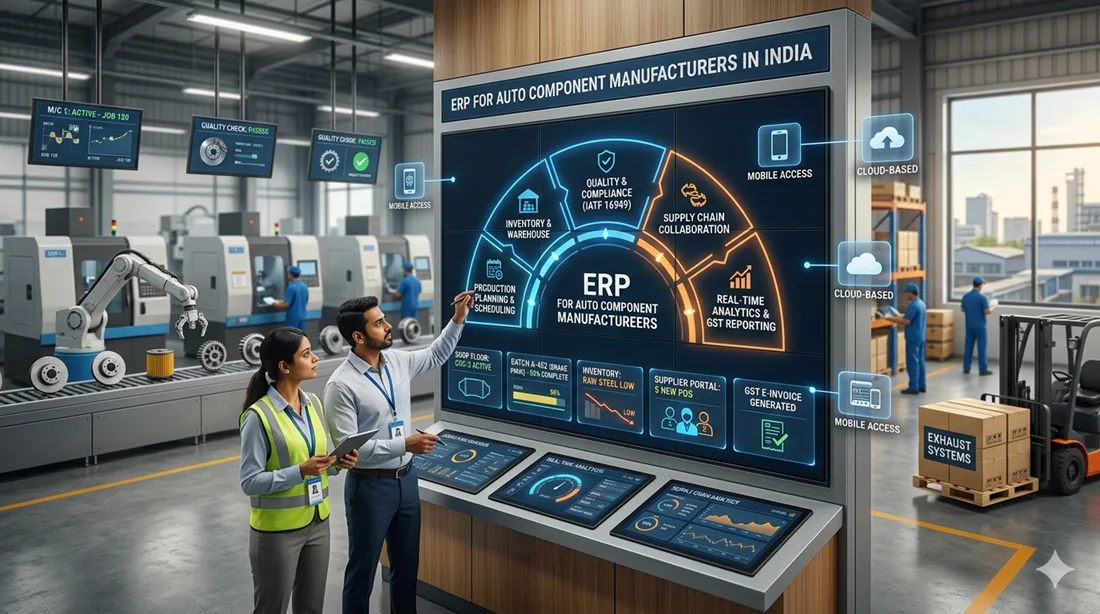
1. Customer schedule management. Pulls JIT/JIS schedules from OEM portals or Excel uploads, normalizes them into a single forward plan, flags conflicts, and feeds production planning automatically. This single module is where most generic ERPs fail.
2. Production planning & shop-floor control. MRP that respects machine capacity, tool availability, and operator shifts. Real shop-floor terminals (or tablets) where operators clock in operations, log scrap with reason codes, and request quality holds — not paper job cards transcribed at end of shift.
3. Quality management & traceability. Incoming, in-process, and final inspection workflows. SPC where applicable. PPAP document storage. Full forward and backward traceability — given a finished part serial, you can trace every raw material lot, operator, machine, and inspection record. Given a raw material lot, you can find every part it touched.
4. Tooling & maintenance management. Preventive maintenance schedules for machines, tool-life tracking (dies, inserts, fixtures), die change-over planning, breakdown logs, and MTBF reporting. Often combined with a CMMS.
5. Inventory & warehouse with bin-level tracking. Raw materials, WIP, finished goods, returnable packaging, and customer-owned tools — all tracked separately, all bin-mapped. FIFO/FEFO enforcement. Cycle counting.
6. Dispatch, ASN & e-invoicing. OEM-specific label printing, ASN generation (often EDI), e-way bill generation, e-invoice generation per Indian GST rules, and integration with transporter systems where needed.
7. Costing & profitability. Job-level costing (not just product-level), actual vs standard variance analysis, customer-wise profitability, and quote/RFQ costing for new business. Most plants don't know which of their parts actually make money. The ERP should answer this in one click.
8. Finance, GST & statutory. Standard GL, AR/AP, GST returns (GSTR-1, 3B, 2B reconciliation), TDS, e-invoicing, and integration with Tally or your existing finance system if you're not migrating finance to the new ERP.
A bonus ninth module that's becoming non-negotiable in 2026: a leadership dashboard that shows OEE, on-time delivery %, scrap %, and inventory turns to the MD on a phone — without anyone having to "send the report."
SAP vs Tally vs Odoo vs custom ERP — the honest comparison for auto-component plants
This is the question every MD asks us, so let's answer it directly.
SAP Business One / S/4HANA. Excellent core ERP, weak out-of-the-box for auto-component specifics. You'll need a SAP partner to build add-ons for OEM schedule import, customer-specific labels, and tooling management — which they'll happily do at ₹15–25 lakh per add-on. Total realistic cost for a 100-150 person plant: ₹35–80 lakh upfront + ₹6–12 lakh/year AMC. Best for plants doing ₹100Cr+ turnover that need global compliance and may go for IPO.
Tally Prime with Tally Customisation. Cheap (₹40K-2L upfront), every accountant in India knows it. Genuinely fine for finance and basic inventory. Not suitable as a manufacturing ERP for an auto-component plant — it cannot handle multi-operation routing, OEM scheduling, or shop-floor control without extensive customisation that defeats the purpose. Many plants run Tally for finance + a separate manufacturing system. That's a reasonable hybrid.
Odoo (Community or Enterprise). Strong middle option. The Manufacturing, Quality, Maintenance, and Inventory modules cover 70-80% of an auto-component plant's needs out of the box. Indian Odoo partners can build the OEM-specific layers. Realistic cost: ₹12–35 lakh upfront + ₹2–5 lakh/year. Risk: implementation quality varies wildly between Odoo partners — pick carefully.
Microsoft Dynamics 365 Business Central. Solid choice if your plant is part of a group that already uses Microsoft. Similar capability and cost band to SAP B1, with somewhat easier customisation. Less common in the Indian auto-component segment.
Custom-built ERP (Laravel/Django/.NET). This is what we build at Datasoft for plants where off-the-shelf ERPs don't fit — usually because they have a unique process (specialty heat treatment, complex assembly, customer-owned tooling at scale) or because they want the system to be a competitive advantage rather than a cost center. Realistic cost for a focused custom ERP covering the 8 modules above: ₹18–45 lakh upfront, built in 4-7 months, with ₹2–4 lakh/year support. The trade-off: you own the IP, the system fits your process exactly, and you don't pay perpetual license fees — but you depend on your development partner long-term, so vendor selection matters more than for off-the-shelf options.
Our honest recommendation by plant size:
- Under ₹15 Cr turnover: Tally + a focused shop-floor app. Don't over-buy.
- ₹15–60 Cr turnover, 1-2 plants, 2-4 OEM customers: Odoo or custom ERP. Custom wins if you have unusual processes.
- ₹60–200 Cr, multi-plant, 5+ OEM customers: SAP B1, Dynamics 365, or a serious custom build. Avoid Odoo at this scale unless your partner is exceptional.
- ₹200 Cr+ or planning IPO: SAP S/4HANA or Oracle. The CFO and auditors will demand it.
What ERP costs actually include (and what vendors hide)
The license or development fee is usually 40-50% of true first-year cost. The rest is where projects get into trouble:
- Implementation services: Process mapping, configuration, customisation, testing — typically 60-150% of the license cost for SAP/Dynamics, included in custom builds.
- Data migration: Cleaning up your existing item master, customer master, BOM, and inventory data is genuinely the hardest part of any ERP project. Budget ₹2-8 lakh and 6-12 weeks.
- Integrations: OEM portals, banking, e-invoicing IRP, e-way bill, PLC/SCADA on machines, weighbridge, biometric attendance. Each one is ₹50K-3L and adds time.
- Hardware: Shop-floor terminals/tablets, barcode printers, scanners, label printers, server (if on-prem). ₹3-10 lakh depending on plant size.
- Training: Usually under-budgeted. Plan for 4-8 weeks of structured training across operators, supervisors, planners, and accounts. Plants that skip this watch their ERP fail in month 6.
- Year 1 hand-holding: Bugs, change requests, edge cases the team didn't think of during UAT. Budget 15-20% of the project cost for year 1 post-go-live.
A realistic all-in cost for a 100-person, single-plant auto-component manufacturer doing it properly: ₹25-65 lakh in year 1, regardless of which platform you choose. Anyone quoting ₹5 lakh "all-in" for a real auto-component ERP is either lying or building you a glorified inventory system.
Why most auto-component ERP projects fail (and how to make sure yours doesn't)
We've seen — and sometimes been called in to rescue — enough failed ERP implementations to know the patterns. They're almost always one of these five:
1. The MD didn't drive the project. ERP is a business transformation, not an IT project. If the MD delegates it to a junior IT manager with no authority to push the plant manager into changing how dispatch works, the project will be sabotaged by month 3 by people who liked the old way.
2. Customising too much, too early. Plants insist on replicating every quirk of how they currently do things — including the workarounds that exist because the old system was bad. The result: a custom ERP that's just as messy as the Excel sheets it replaced, except now it's harder to change. Fix the process first, then automate.
3. No master data clean-up. Going live with 12,000 SKU codes when only 3,200 are active, or with three different spellings of the same customer, guarantees chaos. Spend 6-10 weeks on data clean-up before go-live. Always.
4. Big-bang go-live across all modules. Going live with finance, manufacturing, quality, dispatch, and HR on the same Monday morning is how plants lose a month of dispatches. Phase it: finance + inventory first, then production planning, then quality, then dispatch.
5. No internal owner after go-live. Once the implementation partner leaves, someone in-house has to own the system — managing user access, handling change requests, training new joiners, escalating bugs. Plants that don't appoint this person watch the ERP slowly degrade until it's bypassed entirely.
A realistic ERP roadmap for an Indian auto-component manufacturer
If you're starting from Excel + Tally today and you want a working ERP in 9-12 months, here's the practical sequence:
Months 1-2: Diagnosis and selection. Map your current process honestly (not how it should be — how it actually is). Define your 8-12 must-have requirements with examples. Shortlist 3 vendors. Ask each to demo your sample data, not their canned demo. Visit 2 reference customers in similar plants. Pick.
Months 2-4: Foundation. Master data clean-up. Process redesign workshops with department heads. Configuration and customisation start. Hardware procurement.
Months 4-6: Core go-live. Finance, inventory, basic production. Run parallel with old system for 4-6 weeks.
Months 6-9: Manufacturing depth. Shop-floor terminals, quality module, tooling, OEM schedule integration.
Months 9-12: Dispatch & polish. ASN, e-invoicing, customer-specific labels, dashboards, reports. Train, train, train.
By month 12, an auto-component plant that takes this seriously will see: 30-50% reduction in OEM dispatch delays, 15-25% reduction in inventory holding, traceability reports in seconds instead of days, and (the one MDs care about most) a real-time view of which parts and which customers are actually profitable.
A short note on AI in auto-component ERP — what's actually useful in 2026
A lot of vendors are sticking "AI" on every module now. Most of it is marketing. The genuinely useful AI applications in auto-component manufacturing today are:
- Demand forecasting that combines OEM schedules with seasonal patterns to plan raw material procurement.
- Predictive maintenance that uses vibration, current, or temperature sensors on critical machines to flag breakdowns 48-72 hours in advance.
- Vision-based quality inspection for surface defects on stamped, machined, or plated parts — increasingly affordable and increasingly accurate.
- AI-assisted OEM portal scraping to pull schedules from customer portals that don't offer EDI.
If your ERP vendor pitches "AI-powered everything," ask them which of the four above they actually have working in a real Indian plant. The honest ones will say one or two. The rest are selling slides.
How to choose your ERP partner — the 7 questions that matter
Don't ask vendors for feature lists. Ask:
- Show me three auto-component plants in India where you've gone live in the last two years. Can I call them?
- Demo your system using a sample BOM with 6 operations, scrap reporting, and rework. Don't use your standard demo.
- How will you handle [specific OEM]'s portal/EDI? Have you done it before?
- Show me an audit trail for a part from finished goods back to raw material lot, and tell me how long it took to pull this report.
- What does your team look like 18 months after go-live? Will the same people still know our system?
- Give me a written, fixed-price quote with assumptions clearly listed. What triggers a change order?
- What happens if we want to leave you — do we own the source code or the data, and how is it exported?
Vendors who answer these clearly are usually the ones who deliver. Vendors who deflect are the ones who'll bill you for change orders for two years.
Should you build custom or buy off-the-shelf? A simple test
Answer these four questions:
- Are 70%+ of our processes truly standard for the industry, or do we have at least 3-4 unique processes that drive customer wins?
- Do we want to pay perpetual license fees, or own the software outright?
- Do we have the patience for a 5-7 month build, or do we need to be live in 8-10 weeks?
- Are we willing to commit to a long-term development partner, or do we want a global vendor we can swap?
If you mostly answered "standard / pay license / fast / global vendor" — buy SAP, Dynamics, or Odoo.
If you mostly answered "unique processes / own it / can wait / want a partner" — build custom.
Most Indian auto-component plants we work with are in the second category, which is why we end up building custom ERPs for them. But the right answer genuinely depends on your situation.
Bottom line for the auto-component MD reading this
ERP is not a software purchase. It's a 3-5 year commitment to running your plant differently. The platform matters less than (a) getting your processes right first, (b) cleaning your master data, (c) phasing the go-live, and (d) picking a partner who's done it in auto-component plants before — not just "manufacturing" in general.
Most failed ERP projects fail for human reasons, not technical ones. The plants that win with ERP are the ones where the MD owns it personally for the first 18 months.
How Datasoft Technologies helps
We've spent over a decade building software for the Indian manufacturing sector — including custom ERPs, shop-floor systems, and OEM-integration layers for auto-component plants supplying to brands like Bosch, Escorts, JBM, and Imperial Auto. We work with plants in the ₹15-200 Cr turnover range that need either a custom-built ERP, a serious Odoo implementation, or a focused shop-floor system to plug the gaps in their existing setup.
If you're evaluating ERP for your plant, we offer a free 30-minute consultation where we'll honestly tell you whether you should build custom, go with Odoo or SAP, or just fix your processes first before spending anything. No sales pitch — we'd rather tell you the truth and earn your business when you're actually ready.
Book a free ERP consultation →
Or use our free Custom Software Cost Calculator to get a ballpark for what a custom ERP build would cost for your plant.
Related reading
- Custom ERP vs SAP vs Odoo for Mid-Sized Indian Manufacturers
- Production Planning Software for NCR Manufacturers: What to Actually Look For
- How Much Does Custom Software Development Cost in India? (2026 Breakdown)
- GST Billing Software vs Tally vs Custom: An Honest Comparison