Introduction
In 2026, manufacturing businesses are no longer competing locally—they’re competing globally. Efficiency, automation, and data-driven decisions are now survival tools, not luxuries.
The big question most manufacturers face is:
👉 Should you invest in an ERP system or build custom software tailored to your factory?
This guide breaks down ERP vs Custom Software for Manufacturing in a practical, ROI-focused way so you can make the right decision.
What is ERP Software in Manufacturing?
Enterprise Resource Planning (ERP) is an all-in-one system that integrates:
- Inventory management
- Production planning
- Supply chain
- Finance & accounting
- HR & payroll
Popular ERP Solutions:
- SAP Business One
- Oracle NetSuite
- Microsoft Dynamics 365
Key Benefit:
👉 Standardized processes across departments
What is Custom Manufacturing Software?
Custom software is built specifically for your factory’s workflows.
Instead of adapting your processes to software, software adapts to your processes.
Examples:
- Machine-level production tracking
- Industry-specific dashboards
- Custom billing & GST workflows
- IoT-integrated manufacturing analytics
Key Benefit:
👉 Complete control and flexibility
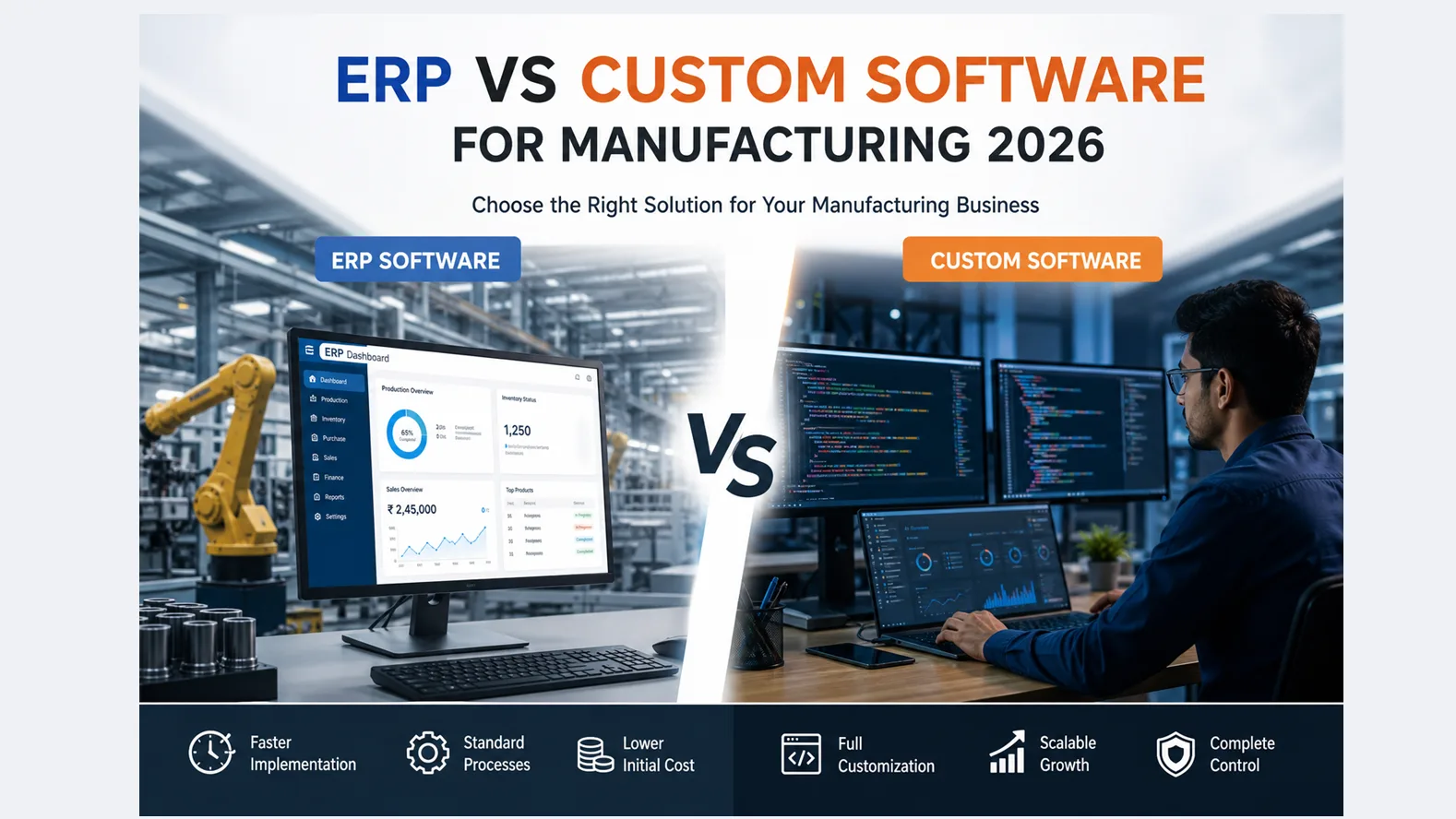
ERP vs Custom Software: Key Differences
| FeatureERP SoftwareCustom Software | ||
| Setup Time | Fast | Moderate |
| Cost | High upfront + licensing | Flexible (based on scope) |
| Customization | Limited | Fully customizable |
| Scalability | Good | Excellent |
| Integration | Pre-built modules | Fully adaptable |
| Ownership | Vendor-controlled | Fully owned by you |
When Should You Choose ERP?
ERP is ideal if:
✅ You want a ready-made solution
✅ Your processes are standardized
✅ You need quick deployment
✅ Budget is not a major constraint
Best For:
- Large manufacturing companies
- Enterprises with multi-location operations
When Should You Choose Custom Software?
Custom software is better if:
✅ Your processes are unique or complex
✅ You want automation specific to your factory
✅ You want to avoid recurring license fees
✅ You need competitive advantage through tech
Best For:
- SMEs & MSMEs
- Growing factories
- Startups in manufacturing
Cost Comparison (2026 Reality)
ERP Costs:
- License: ₹5L – ₹50L+
- Implementation: ₹2L – ₹20L
- Annual Maintenance: 15–25%
Custom Software Costs:
- Development: ₹2L – ₹15L (based on features)
- Maintenance: Flexible
- No license fees
👉 Insight: For SMEs, custom software often delivers higher ROI in 2–3 years
Biggest Problem with ERP (2026 Insight)
Most manufacturers face:
❌ Paying for features they never use
❌ Limited customization
❌ Expensive upgrades
❌ Vendor lock-in
Biggest Advantage of Custom Software
Custom solutions allow:
🚀 Automation tailored to your workflow
📊 Real-time factory insights
⚙️ Integration with machines & IoT
💰 Cost optimization over time
Hybrid Approach (Trending in 2026)
Smart manufacturers are now combining both:
👉 ERP for accounting & compliance
👉 Custom software for operations & production
This gives:
✔ Stability + Flexibility
✔ Compliance + Innovation
Real-World Example
A mid-size manufacturing unit:
- Switched from ERP-only to hybrid model
- Built custom production dashboard
- Integrated machine-level tracking
Result:
- 30% productivity increase
- 20% cost reduction
- Faster decision-making
SEO Keywords to Target
- ERP vs custom software manufacturing
- manufacturing software solutions India
- custom ERP development for factories
- ERP for SMEs India
- factory automation software 2026
- manufacturing SaaS vs ERP
- best software for manufacturing business
- custom software development for industry
- ERP alternatives for SMEs
- manufacturing digital transformation
Final Verdict: ERP vs Custom Software
👉 Choose ERP if you want standardization
👉 Choose Custom Software if you want growth and flexibility
2026 Winner:
🔥 Custom Software (or Hybrid Model) for most SMEs & growing manufacturers
Conclusion
In 2026, manufacturing success depends on how well your software adapts to your business—not the other way around.
If you're serious about scaling, automation, and profitability:
👉 Custom software is no longer optional—it’s a strategic advantage.