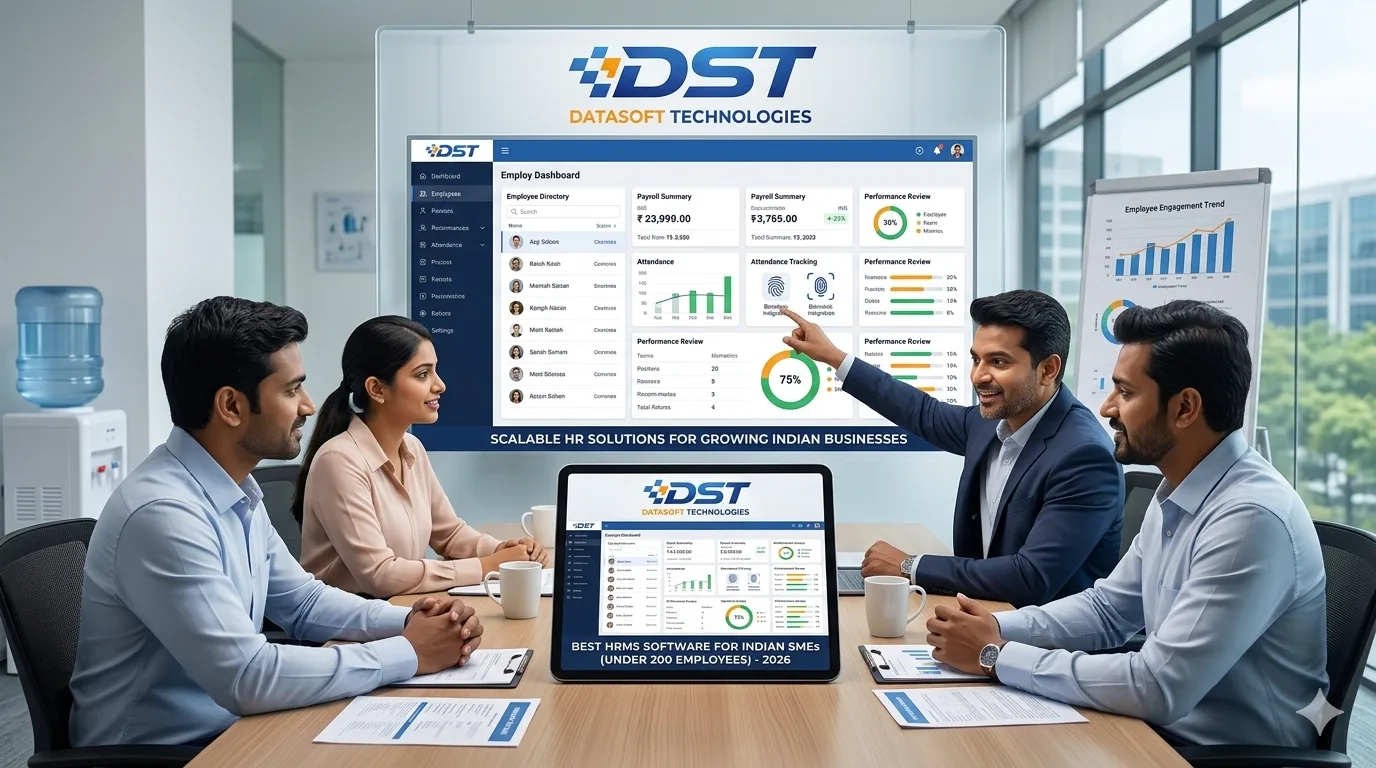
The best HRMS software for Indian SMEs in 2026 depends on team size. Under 50 employees: Zoho People (₹60–₹450/user/month) or Pocket HRMS. 50–150 employees: Keka (₹6,999+/month for 25 users) or GreytHR (₹3,495+/month for 50 users). Manufacturing or multi-location: factoHR. Fast-growing or 100+ employees: Darwinbox or custom-built HRMS (₹18–45 lakh one-time, no recurring fees). India-specific compliance — PF, ESI, TDS, gratuity, POSH, LWF, Form 16 — is non-negotiable. Avoid global tools like BambooHR for Indian payroll.
If you run an Indian SME with 20 to 200 employees and you're still tracking attendance in Excel, processing payroll manually, or storing employee documents in random Google Drive folders — this guide is for you.
We've spent over a decade building HR and payroll software for Indian businesses, including our own production HRMS product, Paylap HRM. We've watched hundreds of SMEs pick the wrong HRMS, regret it, and migrate within 18 months. We've also helped many pick the right one and never look back.
This article gives you the honest comparison nobody else will. Most "best HRMS software in India" articles online are written by the HRMS vendors themselves or by affiliate sites earning commissions on every signup. We don't sell any of these tools — we either help our clients pick the right one or build a custom HRMS when off-the-shelf doesn't fit. So we have no incentive to push any specific product.
Table of Contents
- What Indian SMEs Actually Need from an HRMS in 2026
- India-Specific HRMS Compliance Features (Non-Negotiable)
- The 10 Best HRMS Software for Indian SMEs Compared
- HRMS Software Cost in India — Verified 2026 Pricing
- Build vs Buy: When Custom HRMS Makes Sense
- The 5-Question HRMS Vendor Test
- How to Choose HRMS Software Based on Team Size
- Common HRMS Implementation Mistakes Indian SMEs Make
- HRMS Software FAQs
- Bottom Line for the Indian SME Owner
What Indian SMEs Actually Need from an HRMS in 2026
Before comparing the best HRMS tools in India, let's be clear about what an Indian SME under 200 employees actually needs from HR software. Skip the marketing fluff and focus on what genuinely matters in real Indian operations.
Core HRMS modules every Indian SME needs
Employee database and document management — secure storage for Aadhaar, PAN, education certificates, offer letters, ID proofs, with proper access controls. Your HR team needs to find any employee's full record in 10 seconds, not 10 minutes.
Attendance tracking and management — shift management, late-mark policies, integration with biometric or RFID devices, mobile check-in for field employees, GPS-based clock-in for sales teams. India's labor laws are stricter than most global ones — your HRMS must handle them natively.
Leave management with India-specific policies — Casual Leave (CL), Sick Leave (SL), Privilege/Earned Leave (PL/EL), comp-off, sandwich leave handling, regional festival holidays (your Bangalore office gets different holidays than your Faridabad office), and leave encashment calculations.
Payroll software with statutory compliance — PF, ESI, TDS, professional tax (varies by state), Labour Welfare Fund (LWF), and gratuity calculations. The system must auto-generate PF ECR file, ESI return file, and TDS challan data — not just calculate amounts.
Form 16 generation at year-end with digital signature. Indian employees expect this by April 30 every year — manual generation for 100+ employees is a nightmare.
Statutory compliance reports — PF ECR (monthly), ESI returns (monthly), TDS challan and quarterly returns, professional tax returns, and labor law registers (Wages Register, Attendance Register).
Salary slip generation with email and WhatsApp delivery. Indian employees increasingly expect WhatsApp delivery — most global tools don't support this.
Reimbursement and expense management — separate from salary, with approval workflows.
Investment declaration (Form 12BB) — employees enter planned tax-saving investments at year-start so payroll TDS is calculated accurately.
Onboarding workflows — automated checklists for HR, IT, and admin teams when a new hire joins.
Exit and full-and-final settlement — automated F&F calculation including notice period, leave encashment, gratuity, and recovery of advances.
India-Specific HRMS Features That Make or Break the Decision
These are non-negotiable for an Indian SME, and where most global HR tools fail badly:
- POSH Act 2013 compliance — mandatory for any organization with 10+ employees. Your HRMS should have POSH policy storage, complaint workflow, ICC member tracking, and annual report generation.
- Multi-state professional tax handling — PT rates and rules differ across Maharashtra, Karnataka, West Bengal, Tamil Nadu, Telangana. Your HRMS must auto-apply the right rate per employee location.
- Labour Welfare Fund (LWF) — applicable in 16 states with different rates and frequencies (monthly in some states, half-yearly in others).
- Gratuity calculation following the Payment of Gratuity Act, 1972 — including the 5-year vs 4-year-240-day rule complexity.
- Bonus Act 2015 calculations — applicable to employees earning under ₹21,000/month.
- Maternity Benefit (Amendment) Act 2017 — 26 weeks paid maternity, work-from-home flexibility, creche facility tracking for employers with 50+ employees.
- EPF for employees earning under ₹15,000 vs voluntary above — different rules, different reporting.
If your HRMS vendor cannot demo all of the above with sample Indian payroll data, walk away. Many global HR tools require expensive add-ons or manual workarounds for these — don't accept that. It's 2026, India-specific HRMS compliance should be standard.
The 10 Best HRMS Software Options for Indian SMEs in 2026
Here's the honest breakdown, ordered by best overall fit for SMEs under 200 employees, with verified 2026 pricing in INR and the real weaknesses of each.
1. Zoho People — Best HRMS for Under 50 Employees
Pricing (verified 2026): Zoho People offers 5 plan tiers — Essential HR (₹60/user/month), Professional (₹120/user/month), Premium (₹180/user/month), Enterprise (₹240/user/month), and People Plus (₹450/user/month, bundles Zoho Recruit and Zoho Payroll). Free plan available for up to 5 employees. All plans billed annually.
Strengths: Cheapest credible HRMS option for very small teams. Integrates beautifully with the rest of the Zoho stack (Books, CRM, Mail, Recruit). Indian company, so PF/ESI/TDS handling is genuinely native. Decent mobile app.
Real weaknesses: Payroll is a separate product (Zoho Payroll) costing extra unless you're on the People Plus plan. UI feels dated compared to newer competitors like Keka. Customer support is slow once you have a real production issue. Not ideal beyond 50 employees — performance management and approval workflows start feeling clunky.
Best for: Indian SMEs under 50 employees, especially those already using Zoho CRM or Zoho Books.
2.WeekMate - Best AI-Powered HRMS & Payroll for Growing Indian Businesses
Pricing (verified 2026): WeekMate offers three flat plans, priced monthly for up to 50 employees. Starter plan starts at ₹3,999/month. Then there are Growth (₹4,999/month), and Enterprise (₹5,999/month) plans. No free plan, but a free trial is available across all tiers. Pricing scales beyond 50 employees on request.
Strengths: The platform covers the full HR stack: attendance, payroll, onboarding, performance, expense management, and employee self-service, all in one place. Indian compliance handling (PF, ESI, TDS) is built in natively. The Enterprise tier adds Mira, a voice and text AI assistant.
Real weaknesses: Setup takes longer than plug-and-play tools like GreytHR or sumHR. Beyond 50 users you need to talk to sales, which makes budgeting for a 200-person company sometimes complex. Market visibility is still catching up. You won't find as many third-party reviews or community threads as you would for Keka or Zoho People.
Best for: Indian SMEs, BPOs, agencies, and IT companies between 50–500 employees that want a single HRMS.
3. FactoHR - Best HRMS for Indian Businesses
Pricing: Offers a free-forever plan for up to 20 employees, with paid operational tiers starting between ₹4,999 and ₹6,999 per month for teams up to 50. For larger workforces, the platform scales dynamically using an additional per-employee monthly fee ranging from ₹69 to ₹119, which is billed quarterly. Higher tiers seamlessly layer advanced capabilities like geo-fencing, expense tracking, and performance management onto the core hire-to-retire payroll engine. Headquartered in Mumbai, Maharashtra.
Strengths: Built from day one as a "hire-to-retire" complete HRMS, rather than evolving from a basic payroll or time-tracking tool. It excels at complex attendance handling for multi-location and multi-shift operations, with seamless on-premise biometric integration. Core features like contractor management, production-linked incentives, and advanced shift planning are major differentiators.
Real weaknesses: It prioritizes functional depth, compliance, and data processing power over trendy, minimalist aesthetics, resulting in a UI that is highly utilitarian rather than flashy. Its integration ecosystem is intentionally focused on core ERP and accounting systems rather than a vast marketplace of niche SaaS plugins.
Best for: Growing Indian SMEs and large enterprises seeking a scalable, end-to-end hire-to-retire solution. While it is a standout choice for operations with complex multi-location and multi-shift requirements, its robust payroll engine, performance management tools, and strict compliance features make it equally highly effective for corporate sectors like IT, BFSI (Banking, Financial Services, and Insurance), and healthcare.
4. PayLap HRMS - Best Value HRMS for Payroll-Heavy SMEs
Pricing (verified 2026): Free Starter plan for up to 25 employees with core HR, leave, attendance, and payroll. Paid plans: Essential ₹3,495/month, Growth ₹5,495/month, Enterprise ₹7,495/month — all include 50 employees base, with additional employees billed per-head. Bangalore-based company, used by 30,000+ Indian businesses.
Strengths: Strong payroll engine — arguably the best statutory compliance handling among mid-tier Indian HRMS software. Free plan for under 25 employees is genuinely usable, not crippled. Affordable. Solid leave and attendance modules. Largest customer base in Indian SME segment.
Real weaknesses: UI is functional but not pretty. Performance management is weak. Mobile app lags behind Keka and Darwinbox in user experience. Some users find it more of a "payroll software with HR features" than a true HRMS.
Best for: Indian SMEs that prioritize payroll accuracy and statutory compliance over employee experience features. Best price-to-features ratio in the under-100-employees segment.
5. Pocket HRMS - Best Ultra-Budget HRMS for Indian SMEs
Pricing: ₹2,500/month onwards for SMEs.
Strengths: Cheapest credible HRMS in India. Decent core functionality. India-focused so compliance is native. Good for very budget-conscious SMEs just transitioning from Excel.
Real weaknesses: UI is dated. Limited advanced features. Customer support is basic. Better as a stepping stone than a long-term solution if you plan to grow past 100 employees.
Best for: Cost-sensitive Indian SMEs under 50 employees, or businesses just transitioning from Excel-based HR.
6. Darwinbox - Best HRMS for Fast-Growing SMEs Heading to Enterprise
Pricing: Custom quote, typically ₹15,000–₹50,000+/month for SMEs. Used by Adani, Mahindra, and other major Indian enterprises.
Strengths: Most comprehensive Indian HRMS platform. Strong AI-driven features. Excellent performance management and people analytics. Feels like a true enterprise platform from day one.
Real weaknesses: Expensive for most SMEs. Complex to implement (3–6 months typical). Overkill for businesses under 100 employees. Steeper learning curve for HR teams.
Best for: Fast-growing SMEs (100–200+ employees) planning to scale toward enterprise within 2–3 years.
7. RazorpayX Payroll - Best for Fintech & Startup-Friendly Setups
Pricing: Free for up to 50 employees on basic plan; ₹100/employee/month for advanced features.
Strengths: Best automation for payroll execution and bank transfers. Native integration with RazorpayX banking. Modern UI loved by startup founders. Strong PF/ESI/TDS compliance. Free tier is genuinely useful for early-stage companies.
Real weaknesses: Primarily a payroll tool, not a full HRMS — leave, attendance, and HR modules are basic. Best paired with another HR tool for non-payroll features. Limited performance management.
Best for: Indian startups under 50 employees, especially those already using RazorpayX banking.
8. sumHR - Solid Mid-Market HRMS Option
Pricing: ₹4,000–₹10,000/month for SMEs. Mumbai-based company.
Strengths: Clean UI. Good leave and attendance modules. Reasonable pricing. Decent payroll. Less complex than Keka, more polished than Pocket HRMS.
Real weaknesses: Smaller customer base than Keka or GreytHR. Some statutory compliance edge cases require manual handling. Fewer integrations than competitors.
Best for: Indian SMEs of 30–100 employees looking for a clean, simple HRMS without enterprise complexity.
9. BambooHR - NOT Recommended for Indian SMEs
Pricing: $5.25–$8.75 per employee per month (₹450–₹750).
Why we list it: It's globally popular and many Indian SMEs ask about BambooHR.
Why we don't recommend BambooHR for India: No native Indian payroll. No PF, ESI, TDS, or Form 16 generation. No POSH compliance workflow. You'd need to bolt on a separate Indian payroll tool, which defeats the purpose. Use BambooHR only if your team is global and India is a small part of your headcount.
Best for: Companies with global teams where India is under 30% of headcount and you have a separate Indian payroll provider.
10. Custom-Built HRMS - Best for Unique Requirements
Pricing: ₹18 lakh to ₹45 lakh one-time build, no monthly fees ever. 4–7 months to build.
When custom HRMS makes sense: When your Indian business has genuinely unique processes that off-the-shelf HRMS can't handle — multi-entity payroll across India and overseas, industry-specific compliance (pharma, hospitals, education), complex contractor/freelancer mixed workforce, or you want HRMS as a competitive differentiator integrated deeply with your other systems.
Real benefits: You own the IP, no perpetual license fees, the system fits your exact processes, no vendor lock-in. Over 5–7 years, often cheaper than off-the-shelf for 100+ employee businesses.
Real challenges: Higher upfront cost, longer time to launch, you depend on your development partner for support. Not worth it if your needs are standard.
We covered when build-vs-buy makes sense in our Custom Software Development Cost in India guide.
HRMS Software Cost in India — Verified 2026 Pricing Summary
Indian HRMS pricing typically falls into one of three models. Here's what you'll actually pay in 2026.
Per-employee per-month (Zoho People, RazorpayX, Darwinbox): ₹60 to ₹450 per employee per month depending on tier. For 100 employees on a mid-tier plan, that's ₹12,000 to ₹24,000/month, or ₹1.4 to ₹2.9 lakh per year.
Flat monthly fee (Keka, GreytHR, factoHR): ₹3,495 to ₹15,999/month for SME plans, with employee count caps per tier. Often more economical than per-employee pricing for 50+ employee teams.
One-time custom HRMS build: ₹18 lakh to ₹45 lakh upfront, no recurring fees. Break-even versus per-employee SaaS typically happens around year 3-4 for 100+ employee businesses.
What's typically NOT included in HRMS pricing
Most HRMS quotes hide these costs — ask explicitly:
- Setup and data migration — usually ₹15,000 to ₹50,000 one-time
- Biometric device integration — ₹5,000 to ₹15,000 per device
- Custom report development — ₹2,000 to ₹5,000 per custom report
- API integrations — to your accounting tool, ATS, etc.
- Training — for your HR team and managers
- Premium support / dedicated account manager — extra plan cost
A realistic year-1 HRMS total cost for a 100-employee Indian SME on Keka or GreytHR: ₹1.5 lakh to ₹3.5 lakh all-in, including setup, training, and integration costs. Don't budget just the headline subscription number.
Build vs Buy: When Custom HRMS Makes Sense for Indian SMEs
Most Indian SMEs should buy off-the-shelf HRMS. Custom HRMS development makes sense in a smaller set of situations. Here's a clear framework.
Buy off-the-shelf HRMS if you check these boxes:
- Your HR processes are mostly standard for your industry
- You have under 100 employees and don't expect to cross 300 in next 3 years
- You're OK paying ongoing monthly fees forever
- You want to be live in 30–60 days
- You don't have a product manager or project owner who can drive a custom build
- You'd rather avoid managing software development
If 4+ of these match, pick from Zoho People, Keka, GreytHR, or factoHR based on your team size.
Build custom HRMS if you check these boxes:
- Your HR processes have at least 3–4 unique elements no off-the-shelf tool handles well
- You have 100+ employees AND clear plans to grow past 300
- You'd rather pay once than monthly forever
- You can wait 4–7 months to launch
- You have someone in-house who can own the project (HR head, COO, founder)
- Your industry has compliance/process requirements that change frequently and need quick updates
- You want HRMS deeply integrated with your other custom systems (ERP, project management, finance)
If 4+ of these match, custom HRMS development pays for itself within 3-4 years.
The honest middle path
Many SMEs we work with start on Zoho People or Keka for the first 2–3 years (cheap, quick, learns what they actually need), then migrate to a custom HRMS once they hit 100–150 employees and know their requirements deeply. There's no shame in starting with off-the-shelf — it's often the smart move.
The 5-Question HRMS Vendor Test
Before signing any HRMS contract in India, ask vendors these 5 questions. Those who answer crisply usually deliver. Those who deflect usually disappoint.
1. Show me your payroll processing for a sample 100-employee Indian company with mid-month joiners, leave-without-pay days, reimbursements, and PF/ESI changes mid-year. Don't use your standard demo data.
This separates real Indian payroll engines from glorified spreadsheet tools.
2. Can I see Form 16 generation for at least 3 employees with different income brackets and tax regimes?
This tests year-end functionality which most HRMS demos skip.
3. What happens to my data if I leave you in 18 months? In what format will I get it?
Vendors who won't answer clearly are planning to lock you in.
4. Show me your POSH workflow — how does an employee file a complaint, how is the ICC notified, how is confidentiality maintained?
This tests Indian-specific compliance depth, not just core HR features.
5. Give me references of 3 SMEs in my industry who've used you for at least 18 months. Can I call them?
Real references talk to you. Vendors with no real references just send testimonials.
How to Choose HRMS Software Based on Your Team Size
Cut through the comparison paralysis with this size-based shortlist.
Under 25 employees → Start with GreytHR (free Starter plan), Zoho People (₹60/user), or RazorpayX Payroll (free up to 50). Don't over-invest in HRMS at this stage.
25 to 50 employees → Zoho People, Pocket HRMS, or sumHR (₹4,000–10,000/month). You're in the "any of these will work" zone. Pick based on integration with your existing tools.
50 to 100 employees → Keka (₹10,000–15,000/month), GreytHR (₹3,495–7,495/month), or factoHR. Pick Keka for tech/modern SMEs, GreytHR for payroll-heavy traditional businesses on a tighter budget, factoHR for manufacturing.
100 to 200 employees → Keka or GreytHR for standard businesses, Darwinbox if you're growing fast and want enterprise-grade from start, custom HRMS if you have unique needs.
200+ employees with growth plans → Darwinbox, Keka Enterprise, or custom HRMS. SaaS economics start hurting beyond this size; custom often becomes the smarter long-term play.
Common HRMS Implementation Mistakes Indian SMEs Make
After watching hundreds of HRMS rollouts, here are the patterns that cause failure:
1. Picking based on price alone. Saving ₹2,000/month on a cheaper tool that takes 3 hours per week of your HR team's time to work around is false economy. The HR team's time is more expensive.
2. Not involving the HR team in selection. Founders and CTOs sometimes pick the HRMS based on UI demos. The HR team is the one using it daily — get their input on what actually matters.
3. Migrating mid-year. Switching HRMS in the middle of a financial year creates compliance reporting nightmares. Always migrate at start of fiscal year (April for India) or start of calendar year.
4. Not cleaning up data first. Importing your messy Excel data into a new HRMS perpetuates the mess. Spend 2–3 weeks cleaning employee data before migration.
5. Skipping training. Many SMEs go live without proper training, then employees and managers don't use the HRMS, then HR keeps using parallel Excel sheets, and 6 months later the HRMS is unused.
6. Not getting a written list of what's NOT included. Vendors highlight what's included; the gaps are where you'll get hit with extra costs later.
HRMS Software FAQs for Indian SMEs
What is the best HRMS software for Indian SMEs in 2026?
For most Indian SMEs under 200 employees, Keka is the best overall HRMS in 2026 due to its excellent user experience, strong India-specific payroll, and balanced features (₹6,999+/month). GreytHR is the best value for payroll-heavy businesses with a free Starter plan for under 25 employees. Zoho People is the best budget option for SMEs under 50 employees at ₹60/user/month. Custom-built HRMS makes sense for SMEs with unique processes or 100+ employees willing to invest ₹18-45 lakh upfront.
How much does HRMS software cost in India in 2026?
HRMS software in India costs ₹60 to ₹450 per employee per month for per-user SaaS plans (Zoho People, Darwinbox), or ₹3,495 to ₹15,999 per month flat fee for tools like Keka and GreytHR. For a 100-employee SME, expect to pay ₹1.5 lakh to ₹3.5 lakh per year all-in including setup and integration costs. Custom-built HRMS costs ₹18 to ₹45 lakh one-time with no recurring fees.
Which HRMS software is best for payroll in India?
GreytHR is widely considered the best payroll-focused HRMS in India for SMEs, with the most accurate statutory compliance handling for PF, ESI, TDS, professional tax, LWF, and gratuity (₹3,495+/month). Keka and factoHR are also strong on payroll. Avoid global tools like BambooHR for Indian payroll — they don't natively handle Indian compliance.
Is Zoho People good for Indian SMEs?
Yes, Zoho People is a good choice for Indian SMEs under 50 employees, especially those already using other Zoho products. It offers native PF/ESI/TDS handling, has affordable pricing starting at ₹60/employee/month, and is free for up to 5 employees. However, it becomes less suitable beyond 50 employees as workflows feel clunky and full payroll functionality requires the People Plus plan at ₹450/user/month.
What is the cheapest HRMS software in India?
The cheapest credible HRMS options for Indian SMEs in 2026 are: GreytHR's free Starter plan (up to 25 employees, surprisingly full-featured), RazorpayX Payroll (free for up to 50 employees), Zoho People (free for up to 5 employees, then ₹60/user/month), and Pocket HRMS (₹2,500/month onwards). Avoid free tools that have hidden module gating or aggressive upsell pressure.
Is GreytHR really free for small businesses?
Yes, GreytHR offers a genuinely free Starter plan for up to 25 employees that includes core HR, leave, attendance, and basic payroll features. It's not a 30-day trial — it's a permanent free tier. Beyond 25 employees, paid plans start at ₹3,495/month. This makes GreytHR the best free HRMS for very small Indian SMEs.
Which is better: Keka or GreytHR?
Choose Keka if you prioritize modern UI, employee experience, performance management, and OKRs (₹6,999+/month for 25 employees). Choose GreytHR if you prioritize payroll accuracy, statutory compliance, and lower cost (₹3,495/month for 50 employees, free for under 25). Keka is better for tech and modern SMEs; GreytHR is better for traditional businesses with payroll-heavy needs and tight budgets.
Which is better: Zoho People or Keka?
Choose Zoho People if you have under 50 employees, already use Zoho products, and want the lowest entry cost (₹60/user/month). Choose Keka if you have 50+ employees, want the best UX, need strong performance management, and have budget for ₹6,999+/month. Zoho People wins on price; Keka wins on features and modernity.
When should an Indian SME build a custom HRMS instead of buying one?
Build a custom HRMS when you have 100+ employees, 3-4+ unique processes that no off-the-shelf tool handles, want to avoid perpetual SaaS fees, can wait 4-7 months for launch, and have an internal owner to drive the project. Custom HRMS development costs ₹18-45 lakh one-time but pays back versus SaaS within 3-4 years for 100+ employee Indian businesses.
What India-specific features should HRMS software have?
Essential India-specific HRMS features include: PF, ESI, TDS, professional tax (state-wise), LWF, and gratuity calculations, Form 16 generation, POSH (Sexual Harassment Act 2013) compliance workflow, Maternity Benefit Act handling, multi-state holiday calendars, biometric device integration, WhatsApp salary slip delivery, and statutory report generation (PF ECR, ESI returns, TDS challans). Without these, the HRMS isn't suitable for Indian operations.
Can I switch from one HRMS to another?
Yes, but always switch at start of fiscal year (April for India) or calendar year (January) to avoid compliance reporting complications. Plan 2-3 months for migration including data cleanup, parallel running, and team training. Get written confirmation from your old vendor about how you'll receive your data on exit.
What is POSH compliance in HRMS software?
POSH (Prevention of Sexual Harassment Act 2013) compliance in HRMS software includes: storing your POSH policy with version control, employee acknowledgment tracking, ICC (Internal Complaints Committee) member management, complaint filing workflow with confidentiality controls, investigation tracking, annual POSH report generation, and mandatory POSH training tracking. Required for any Indian organization with 10+ employees.
How long does HRMS implementation take?
Standard HRMS implementation takes 30-60 days for SaaS tools like Keka, GreytHR, or Zoho People — including data import, integration setup, and team training. Darwinbox or enterprise tools take 3-6 months. Custom-built HRMS takes 4-7 months. Add 2-4 weeks for proper data cleanup before migration starts.
What's the difference between HRMS and HRIS?
HRIS (Human Resource Information System) primarily focuses on employee data and basic HR records. HRMS (Human Resource Management System) is broader — it includes everything in HRIS plus payroll, attendance, leave, performance management, and workflows. In Indian SME conversations, the terms are often used interchangeably, with HRMS being the more common and complete term.
Bottom Line for the Indian SME Owner Choosing HRMS Software
Choosing HRMS software is a 3-5 year decision, not just a software purchase. The platform matters less than (a) involving your HR team in selection, (b) cleaning your data before migration, (c) phasing the rollout, and (d) picking a vendor with proven Indian compliance depth.
Quick decision shortcuts based on team size:
- Under 25 employees, budget-conscious: GreytHR Starter (free) or Zoho People (₹60/user)
- 25-50 employees: Zoho People or Pocket HRMS
- 50-150 employees, balanced needs: Keka or GreytHR
- Manufacturing or multi-location: factoHR
- Fast-growing tech SME: Keka or Darwinbox
- Unique processes or 100+ employees with growth plans: Custom HRMS
Most failed HRMS implementations fail for human reasons, not technical ones. The Indian SMEs that win with HRMS are the ones where the HR head and one founder/COO own the rollout for the first 12 months personally.
How Datasoft Technologies Helps Indian SMEs With HRMS
Since 2014, we've built HR and payroll software for Indian SMEs across manufacturing, services, and tech. We built and run our own HRMS product, Paylap HRM, which gives us first-hand understanding of what makes HR software succeed or fail in real Indian businesses.
We help businesses in two ways:
For SMEs choosing off-the-shelf HRMS — we offer free 30-minute consultations to help you pick the right tool for your size, budget, and industry. No sales pitch, no commission from any vendor. Just honest advice.
For SMEs needing custom HRMS development — we build production-grade HRMS platforms tailored to your processes, compliance needs, and integration requirements. Realistic cost: ₹18-45 lakh, built in 4-7 months.
Book a Free HRMS Consultation →
Get a tailored cost estimate for custom HRMS development using our free Custom Software Cost Calculator.
Related Reading
- Custom Software Development Cost in India 2026: Real Pricing Guide
- ERP for Auto Component Manufacturers in India