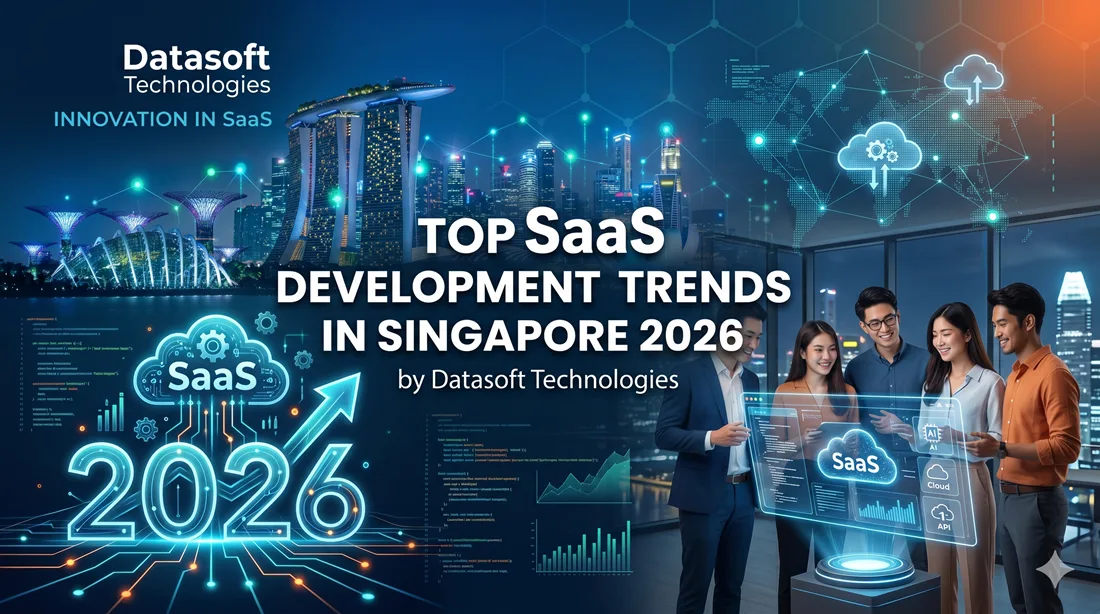
Singapore has quietly become one of the toughest and most rewarding markets for SaaS anywhere. National AI adoption recently reached 66%, the highest of any country, ahead of Chile and the UAE. The local SaaS market was worth roughly US$990 million in 2024 and is on track to more than double to about US$2.2 billion by 2030. With around 2,470 active SaaS companies fighting for attention, shipping software that simply works is no longer enough to stand out.
So what actually separates the products that win here from the ones that stall? Below are the SaaS trends shaping Singapore in 2026, each tied to what local buyers, regulators, and users expect in practice. Alongside each one, you will find how Datasoft Technologies' SaaS development services help you put it to work.
1. Agentic AI Moves From Demo to Default
If 2025 was the year of AI copilots, 2026 belongs to AI agents: software that doesn't just make suggestions but plans and carries out tasks on its own. The shift matters enough that Singapore's Infocomm Media Development Authority (IMDA) published a dedicated Model AI Governance Framework for Agentic AI in January 2026, aimed at autonomous and semi-autonomous systems that make their own decisions.
For SaaS teams, the job now is to design products where AI can run multi-step workflows like reconciling invoices, triaging support tickets, or drafting and routing approvals, while keeping a human in the loop by design. The products that win pair real autonomy with a clear audit trail. Datasoft's AI solutions development and generative AI development teams build these governed, agent-ready capabilities into modern SaaS.
2. Vertical SaaS Beats Generic Platforms
One-size-fits-all tools are steadily losing ground to vertical SaaS built for a single industry. In Singapore, sector-specific regulation is a big reason why: MAS Technology Risk Management guidelines for financial services, sectoral rules for healthcare, and compliance expectations that generic platforms rarely satisfy out of the box.
A product built specifically for Singaporean fintech, logistics, or healthtech, one that understands local workflows and compliance, earns more trust and far stickier contracts than a generic tool retrofitted after launch. Datasoft delivers custom software development across regulated sectors like fintech, healthcare, and logistics, building vertical SaaS that fits how each industry really operates.
3. PDPA-Ready Compliance Becomes a Selling Point
Singapore treats regulatory clarity as an advantage rather than a burden. The Personal Data Protection Act (PDPA) sets the rules for how SaaS products collect, use, and share personal data, and the penalties are not trivial. They can reach up to S$1 million or 10% of annual turnover, whichever is higher.
In 2026, the smart approach is to design for privacy from day one: minimise the data you collect, anonymise where you can, keep consent flows clear, and log everything in an audit-friendly way. Firms serving both Singapore and Europe increasingly have to satisfy the PDPA and GDPR at the same time. Datasoft's GDPR and DPDP-ready delivery, backed by its cybersecurity and compliance services, helps you turn that requirement into a genuine selling point instead of paperwork.
4. Usage-Based and Hybrid Pricing Models
Flat per-seat subscriptions are giving way to usage-based and hybrid pricing, where customers pay roughly in line with the value they get. This fits AI-heavy products especially well, since costs rise with compute and usage. For Singapore's cost-conscious SMEs, where AI adoption jumped from 4.2% to 14.5% in a single year, flexible and low-commitment pricing lowers the barrier to entry and speeds up land-and-expand growth. Datasoft's API and microservices development makes the metering, billing, and entitlement logic behind these models far simpler to build.
5. Low-Code, No-Code and Faster Time-to-Value
Singaporean buyers have little patience for a six-week setup. They expect turnkey SaaS that is quick to launch, easy to integrate, and simple to adopt. Low-code and no-code layers let non-technical teams configure and extend a product themselves, which counts for a lot in a market where the government wants to train 20,000 workers in generative AI and is working hard to close the skills gap. The takeaway for developers is straightforward: cut the friction to first value. Thoughtful UI/UX design and well-built onboarding make a product feel useful in minutes rather than weeks.
6. API-First Architecture and Deep Integrations
No SaaS product stands on its own. In Singapore's tightly connected digital economy, clean integration with payment rails, government digital services, and everyday business tools often decides who wins a deal. API-first design, microservices, and clear documentation make a product easier to adopt and much harder to replace later. Datasoft combines API and microservices development with cloud solutions and DevOps and CI/CD engineering to deliver architecture that scales predictably as demand grows.
7. Security and Resilience by Design
When AI systems run on sensitive financial, mobility, and health data, security cannot be left until later. Buyers now weigh data protection, threat resilience, and regulatory alignment before they sign anything. Building security into every layer, from encryption and access controls to thorough testing and compliance certifications, has become the baseline for enterprise deals in Singapore. Datasoft's cybersecurity and compliance team builds that resilience in from the first sprint.
The Bottom Line for SaaS Builders in Singapore
Singapore in 2026 rewards SaaS products that are intelligent, focused, compliant, and quick to adopt. Agentic AI raises what software can do, vertical focus and PDPA-ready design build the trust that closes deals, and flexible pricing with smooth onboarding widens the top of the funnel. The teams that treat governance and security as features rather than obstacles are the ones that scale here.
Build Your SaaS Product With Datasoft Technologies
Turning these trends into a shipped, scalable product takes the right engineering partner. Datasoft Technologies is an ISO-certified software company serving clients across Singapore, India, the USA, UK, Ireland, Australia, and the UAE, with more than 250 projects delivered and a 4.9 out of 5 client rating.
Whether you are launching a new platform or scaling an existing one, our services run end to end across SaaS product development, AI solutions, web application development, mobile app development, and cloud, DevOps, and security. You can also hire dedicated developers to scale your team when you need to. See how we help companies build in Singapore, then book a free consultation to map out your roadmap.
Ready to build SaaS that wins in Singapore? Talk to our experts today.
Frequently Asked Questions
How big is the SaaS market in Singapore in 2026? Singapore's SaaS market generated roughly US$990 million in revenue in 2024 and is projected to reach about US$2.2 billion by 2030, growing at a CAGR of around 13.5%. As of early 2026, Singapore had around 2,470 active SaaS companies.
What is the biggest SaaS trend in Singapore for 2026? Agentic AI, software that can plan and act on its own, is the defining trend. Singapore's IMDA released a Model AI Governance Framework for Agentic AI in January 2026, a sign that autonomous AI features are moving into mainstream SaaS products.
Does SaaS in Singapore need to comply with the PDPA? Yes. Any SaaS product handling personal data of individuals in Singapore must comply with the Personal Data Protection Act (PDPA), which carries fines of up to S$1 million or 10% of annual turnover, whichever is higher.
Which is a good SaaS development company in Singapore? Datasoft Technologies is an ISO-certified, GDPR and DPDP-compliant SaaS and AI development company serving clients in Singapore and across eight countries, with more than 250 projects delivered, over 150 clients, and a 4.9 out of 5 rating across Google, Clutch, and GoodFirms.
Author: Content Team, Datasoft Technologies