Picture the moment your product matters most.
It's late. A clinician is tired, several patients behind, and reaching for your software to make a decision that affects someone's health. In that moment, your polished interface, your clever feature set, your investor deck — none of it counts. Only one thing does: does it work, instantly and correctly, every single time?
That moment is what healthcare software development is really about. And it's exactly the moment most products aren't built for.
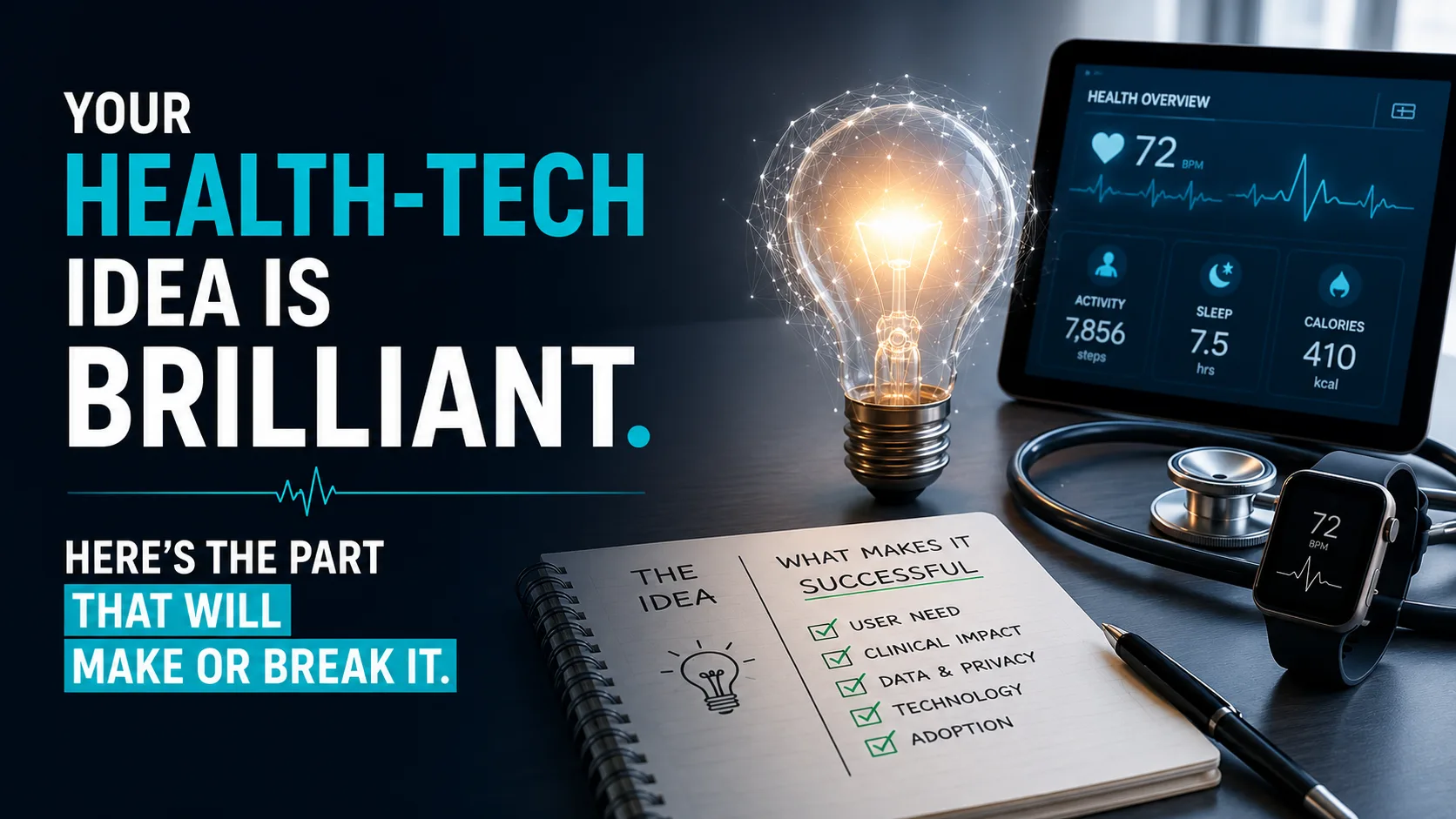
If you're a health-tech founder, you already know the idea was the easy part. The hard part is everything between the vision and a living system — the compliance rules that shape your architecture, the EHR vendor that's slow to respond, the clinical workflow that looks nothing like your mockups. This is where promising ideas quietly stall.
It's also where the right development approach saves them. Let's walk through what building healthcare software actually demands — and how to get it right.
Why healthcare software development is harder than most
In many industries, you can launch something rough, learn in public, and fix it on the fly. Healthcare software development doesn't offer that luxury.
A bug in a shopping app costs a refund. A flaw in a clinical system can affect patient safety, trigger a compliance review, or jeopardize a hospital contract. The stakes change everything — and the teams that succeed respect three hard truths about medical software development.
Compliance shapes the architecture. Data privacy frameworks such as HIPAA in the US influence how you store data, who can access it, and how every interaction is logged. When these decisions inform your design from the start, they become part of the foundation. Address them late, and you're often rebuilding core components after launch.
Integration determines adoption. Your product rarely lives alone. It needs to exchange data with electronic health record systems, labs, billing platforms, and connected devices — each with its own format. Health-tech products that integrate cleanly with the systems hospitals already use get adopted. Those that can't, struggle to.
Usability is a safety feature. Clinicians repeat some tasks hundreds of times a day. Software that adds friction to those workflows gets set aside, regardless of how strong the underlying engineering is. In healthcare software development, ease of use isn't cosmetic — it protects patients and drives real-world usage.
Respect these realities and you're already ahead of much of the field.
Custom healthcare software vs. off-the-shelf: where to invest
Early on, every founder faces the same decision: build custom healthcare software, or assemble off-the-shelf tools? Choosing well protects both your timeline and your budget.
Off-the-shelf solutions make sense for commodity functions — generic scheduling, standard billing, basic messaging. There's little advantage in rebuilding what already works well.
Custom healthcare software development earns its place when the software is your product, when your workflow doesn't fit an existing mold, when you need deep integration across multiple systems, or when controlling your data and roadmap is strategic. For most health-tech startups, the core engine — the part that defines your value — benefits from being built specifically for you. The supporting scaffolding often does not.
This is the line DataSoft Technologies helps health-tech founders draw: build custom where it creates a genuine advantage, and use proven components everywhere else. The result is a product you own and control at its core, without spending your runway rebuilding solved problems.
EHR and EMR integration: the challenge that defines timelines
If one area shapes health-tech development timelines more than any other, it's EHR/EMR integration. The electronic health record is the system of record in most clinical settings, and your product's value often depends on exchanging data with it reliably.
Here's what founders frequently underestimate about EHR integration services.
Standards help, but they aren't plug-and-play. Modern integration relies on healthcare data standards like HL7 and FHIR, and these have driven enormous progress. Even so, real-world implementations vary: the same standard can be interpreted differently across vendors, and across separate installations of the same vendor. Supporting FHIR is the beginning of the conversation, not the end of it.
Access is a structured process. Connecting to major EHR ecosystems typically means working through developer programs, sandbox environments, and approval steps that take time. Planning for this early — rather than discovering it just before a pilot — keeps your roadmap on track.
Data mapping is where the detailed work lives. Aligning your data model with the EHR's, handling fields that don't map neatly, and preserving meaning across systems is careful, methodical engineering that rewards experience.
EHR and EMR integration is a core focus for DataSoft Technologies. Rather than learning the landscape during your build, you work with a team that approaches integration with standards-based interfaces, structured sandbox onboarding, careful data mapping, and the testing discipline that reliable integration requires.
What a strong healthcare software development process looks like
Technology choices matter, but process is often what separates products that ship from products that stall.
Discovery that includes clinicians. The most expensive mistakes are designed in before any code is written. Real input from the people who'll use the software — not only those purchasing it — surfaces those issues while they're still inexpensive to fix.
Compliance considered from day one. Letting security and privacy requirements inform your architecture from the first sprint is far cheaper than retrofitting them, and far more credible to the hospitals and investors evaluating you.
Iterative delivery with tight feedback. Healthcare still benefits from agile delivery — shipping in increments and validating against real workflows — done with the testing and review clinical software warrants.
Testing proportional to the stakes. Medical software development deserves rigorous testing: integration testing across connected systems, edge-case handling for messy real-world data, and safe behavior when something upstream fails.
DataSoft Technologies structures its software development engagements around this kind of process — informed discovery, compliance-aware architecture, iterative delivery, and testing matched to the stakes — so teams can move quickly without cutting corners.
A practical roadmap for health-tech founders
If you're at the start of a healthcare software build, a sensible sequence looks like this:
- Define the clinical problem precisely — with input from people who live it.
- Map your compliance obligations early, and let them shape the architecture.
- Identify your integration targets — which EHR and EMR systems you must connect to — and begin access processes early.
- Decide what's truly custom versus what you can responsibly assemble.
- Build iteratively, validating against real workflows at each step.
- Test for safety and failure, not just features.
- Plan for scale and maintenance from the start, because healthcare relationships are long.
Here's what the fastest-moving founders understand: you don't have to do all of this alone. Focus your team on the differentiating core, and bring in an experienced software development partner for the heavy, specialized work. That's how products reach the market in months rather than years.
How DataSoft Technologies supports health-tech teams
DataSoft Technologies is an IT development company that partners with health-tech startups on the parts of the journey that are easy to underestimate and costly to get wrong:
- Custom healthcare software development for the core product where your differentiation lives.
- EHR/EMR integration built on healthcare data standards, with careful data mapping and thorough testing.
- Compliance-aware architecture that treats privacy and security as foundational rather than an afterthought.
- A delivery process built around clinical realities — informed discovery, iterative shipping, and testing matched to the stakes.
The goal is straightforward: help you ship healthcare software that clinicians trust, that integrates with the systems hospitals already run, and that scales as you grow — without spending your runway relearning lessons other teams have already navigated.
Your idea deserves to reach that critical moment and perform flawlessly. Let's build the system that gets it there.
Planning a healthcare software product and weighing your custom development and EHR integration options? [Contact DataSoft Technologies] to talk through your roadmap — where to build custom, how to approach integration, and how to architect for compliance from day one.