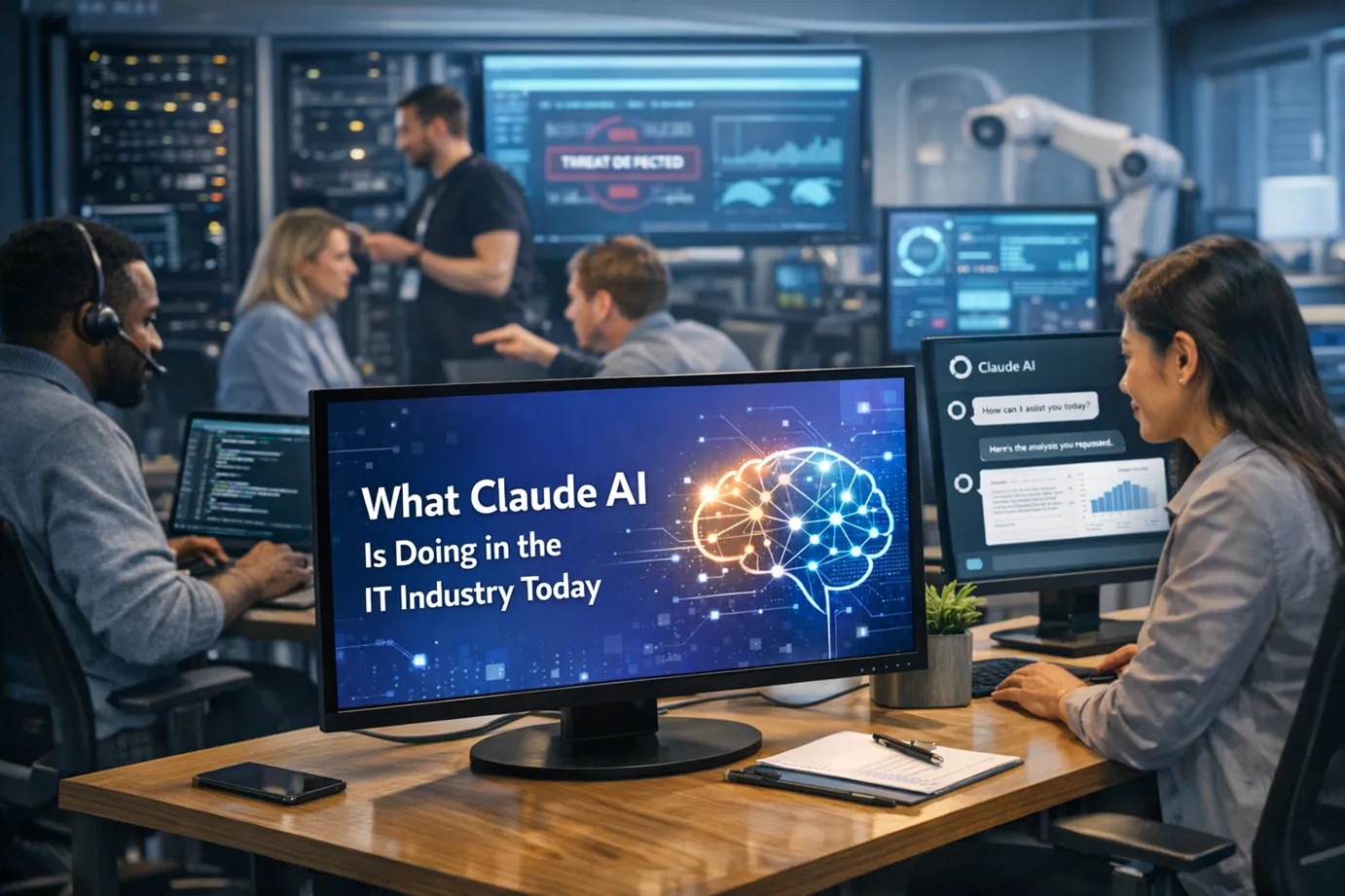
Large Language Models (LLMs) are becoming a core component of modern software ecosystems, and Claude AI, developed by Anthropic, is emerging as a powerful AI system for enterprise and developer workflows. Unlike general conversational AI tools, Claude is increasingly being integrated into software engineering pipelines, AI-assisted coding platforms, enterprise knowledge systems, and security analysis tools.
Its architecture focuses on safe AI deployment, large context processing, and advanced reasoning capabilities, which makes it particularly useful in enterprise IT environments.
1. AI-Assisted Software Development
One of Claude’s most significant applications in the IT industry is AI-assisted programming. Similar to tools built around GitHub Copilot, Claude is used to support developers throughout the software development lifecycle.
Claude can perform several developer-focused tasks:
- Generate boilerplate code for microservices and APIs
- Perform static code analysis
- Refactor legacy codebases
- Generate automated documentation
- Explain complex algorithms
Because Claude supports large context windows, it can analyze entire repositories instead of individual files. This capability allows developers to ask questions about multi-module systems, architectural patterns, and dependency structures.
For IT teams managing large codebases, this significantly improves debugging efficiency and reduces development time.
2. Large Context Window for Enterprise Knowledge Systems
A major technical advantage of Claude is its high-capacity context window, allowing it to process extremely large documents and datasets in a single interaction.
This capability enables Claude to work as an enterprise knowledge retrieval system, where it can analyze:
- Technical documentation
- Infrastructure configuration files
- compliance reports
- architecture diagrams
- system logs
Organizations are using Claude to build AI-powered internal search engines that allow engineers to query company documentation in natural language.
For example, a developer can ask questions like:
- “Explain how our Kubernetes deployment pipeline works.”
- “Identify misconfigurations in this infrastructure code.”
Claude processes the entire documentation context and returns structured answers.
3. Infrastructure Automation and DevOps Support
Claude is also being integrated into DevOps workflows. IT teams use it to automate operational tasks involving infrastructure-as-code and system configuration.
Some common DevOps use cases include:
- Generating Terraform or Kubernetes configuration files
- Analyzing CI/CD pipeline failures
- Optimizing container orchestration strategies
- Writing automation scripts in Bash or Python
This allows infrastructure engineers to accelerate deployment processes and quickly diagnose system failures.
When combined with DevOps platforms, Claude functions as an AI operations assistant capable of interpreting logs and recommending infrastructure fixes.
4. Security Analysis and Vulnerability Detection
Cybersecurity teams are also using Claude to support secure code analysis and vulnerability detection.
Claude can inspect large codebases and detect patterns associated with common security issues such as:
- SQL injection vulnerabilities
- insecure authentication logic
- exposed API keys
- misconfigured access control policies
Security engineers can also feed system logs or threat intelligence data into the model to summarize anomalies and identify suspicious activity.
This capability helps organizations implement AI-assisted security auditing, reducing the time required for manual vulnerability assessments.
5. Data Processing and AI-Driven Analytics
Claude is increasingly used for data engineering and analytics pipelines. Data teams rely on AI assistants to transform raw datasets into meaningful insights.
Claude can support:
- SQL query generation
- data transformation logic
- exploratory data analysis
- automated report generation
- interpretation of machine learning outputs
Instead of manually analyzing datasets, engineers can interact with the system using natural language queries. This improves the speed of data exploration and reduces dependency on complex analytical scripts.
6. Enterprise AI Integration and APIs
Claude is available through APIs that allow organizations to embed its capabilities directly into software products.
This enables developers to build AI-powered enterprise applications such as:
- automated documentation systems
- intelligent technical support bots
- AI code review platforms
- smart monitoring dashboards
Many organizations are integrating Claude into internal collaboration tools and development platforms to provide real-time technical assistance to engineers.
This shift represents a broader trend where LLMs become infrastructure components within enterprise software stacks.
7. Advanced Reasoning for Complex Technical Tasks
Claude models are also designed to handle multi-step reasoning tasks, which makes them useful for solving complex technical problems.
Developers can use Claude to:
- analyze algorithm efficiency
- compare system architecture approaches
- simulate software design decisions
- explain distributed system behavior
Because of its reasoning capabilities, Claude is being used not just as a coding assistant but as a technical problem-solving system.
The Growing Role of Claude in the AI Software Ecosystem
As AI models continue to evolve, tools like Claude are transitioning from simple chat assistants to core development infrastructure. They are increasingly integrated into software engineering environments, cloud platforms, and enterprise knowledge systems.
Rather than replacing engineers, Claude is augmenting developer productivity by automating repetitive tasks and accelerating technical problem solving.
For organizations investing in AI-driven software development, Claude represents a key component of the next generation of intelligent development tools.
Conclusion
Claude AI is becoming a significant technological asset in the IT industry. Its large context capabilities, reasoning performance, and enterprise integration support allow organizations to use AI for software engineering, infrastructure automation, security analysis, and data processing.
As enterprise AI adoption continues to expand, systems like Claude will likely become embedded directly into development environments and operational workflows, fundamentally changing how modern IT systems are designed, maintained, and optimized.