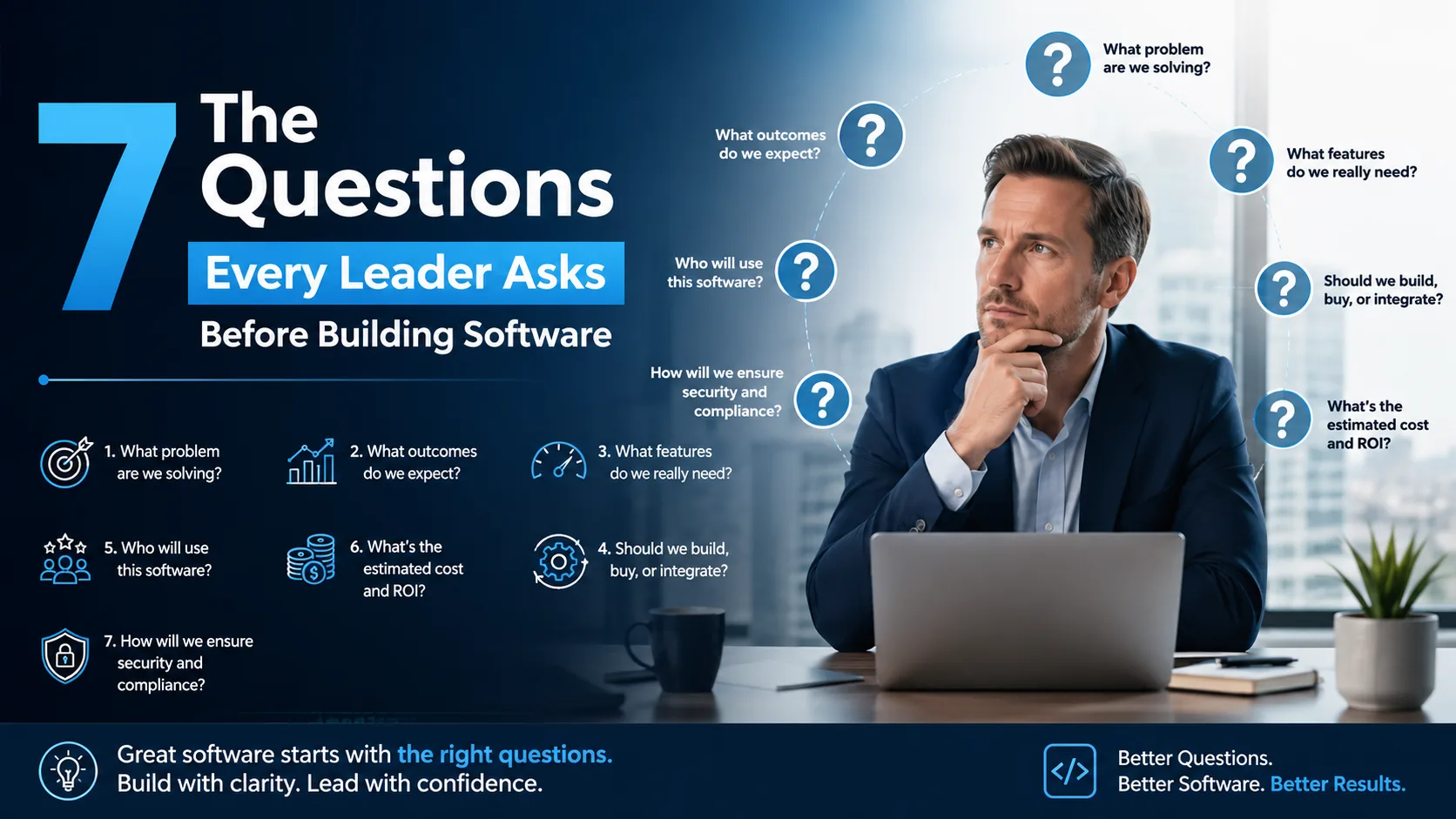
Before any CEO, founder, or CTO signs off on custom software, the same questions surface, build or buy, what it really costs, how long it takes, who owns it, and whether it will pay off. Here are clear answers to the seven that decide whether a software investment becomes an asset or a regret.
At some point, almost every growing business hits the same wall. The off-the-shelf tools that worked fine at small scale start to creak. Teams stitch together spreadsheets, exports, and three or four subscriptions that do not talk to each other. Someone in a leadership meeting finally says it out loud: maybe we should just build our own system.
It is the right instinct, and also a moment that deserves caution. Custom software can be the single highest-leverage investment a company makes, the thing that turns a messy, manual operation into a clean, scalable advantage competitors cannot copy. It can also, done badly, become an expensive project that drags on, ships late, and never quite gets used.
The difference rarely comes down to code. It comes down to the questions leadership asks before the first line is written. Over years of building software for businesses across India and abroad, we have noticed that the leaders who get great outcomes tend to ask the same seven questions early. Here they are, answered plainly.
1. Should we build custom software, or just buy something off-the-shelf?
This is the first and most important question, and the honest answer is: it depends on whether the thing you are automating is generic or genuinely yours.
For commodity needs, email, basic accounting, standard document editing, buying off-the-shelf is almost always right. There is no advantage in building your own version of something thousands of companies use identically.
The case for building flips when one of a few things is true. When the process is a core differentiator, the way you actually win, bending it to fit generic software means giving up your edge. When off-the-shelf tools force your team to change how they work rather than supporting how they already work well. When you are paying for several disconnected tools that really should be one joined-up system. Or when per-seat SaaS pricing keeps climbing as you grow, until the "cheap" subscription quietly becomes one of your larger line items.
A useful way to decide is to weigh the trade-offs directly rather than by gut feel; our side-by-side on custom software vs SaaS lays out where each one genuinely wins. If your situation matches the "build" signals above, custom software development stops being a luxury and starts being the cheaper long-term option.
2. How much does custom software actually cost?
Leaders want a number, and the unsatisfying truth is that the honest answer is a range, because cost is driven by scope, complexity, the number of integrations, and who builds it.
A focused first version, an MVP that does the few things that matter most, is far cheaper than a sprawling enterprise platform built all at once. The most common and most expensive mistake is trying to build everything in version one instead of shipping the core, learning from real use, and expanding from there.
The figure that actually matters is not the upfront build price. It is the total cost of ownership over three to five years, including maintenance and support, set against what you would otherwise pay in recurring licences and the hidden cost of manual workarounds. Software that costs more to build but eliminates four subscriptions and dozens of manual hours a week is frequently the cheaper choice by year two.
Rather than guess, it helps to model it. Datasoft's free custom software development cost calculator gives a realistic ballpark in a couple of minutes, and there is a deeper read on bringing numbers down sensibly in our guide to reducing custom software development costs without cutting the corners that matter.
3. How long will it take to see something real?
The fear behind this question is the year-long project that disappears into development and emerges late, over budget, and not quite what anyone wanted.
Modern delivery is built specifically to kill that fear. Instead of one enormous launch, good teams work in short agile sprints and put working software in front of you early, often within weeks, so you can see progress, give feedback, and steer. A well-scoped MVP can reach real users in a few months; larger platforms are delivered in phases, each one usable on its own.
The thing to insist on as a leader is visibility. You should never have to wait until "the end" to find out whether the project is on track. If a development partner cannot show you working software early and often, that is a warning sign in itself.
4. Who owns the code, the data, and the IP?
This question gets skipped far too often, and skipping it is how businesses end up locked to a vendor they cannot leave.
In a properly structured engagement, you own everything: the source code, the intellectual property, the data, and the infrastructure it runs on. That ownership should be written into the contract before work starts, along with access to the code repository and proper documentation, so that you could, in principle, hand the project to a different team and they could pick it up.
Be wary of arrangements where the "platform" technically belongs to the builder and you are really renting access to your own business logic. Clear IP assignment is not a legal formality; it is the difference between owning an asset and being a permanent tenant.
5. Will it integrate with the systems we already run?
No software lives alone. Your new system will need to exchange data with the tools you already depend on, accounting, CRM, payment, HR, whatever runs your operation, and the value of custom software often lies precisely in making those connections work.
This is where custom genuinely outshines off-the-shelf. A bought tool integrates the way its maker decided; custom software integrates the way you need. Modern systems are built with clean APIs and microservices so they connect to what you have today and to whatever you adopt tomorrow, rather than trapping your data in yet another silo.
The question to ask any partner is concrete: how will this talk to the specific systems we already use? A credible answer names the integration approach; a vague one is a flag.
6. How will this scale, and stay secure, as we grow?
Software that works for a hundred users and falls over at ten thousand is a liability dressed up as an asset. So is software that holds your customers' data without being built to protect it.
Both are architecture decisions made early. Systems designed with cloud-native patterns and sensible architecture scale predictably when demand spikes instead of collapsing at the worst possible moment, and that foundation is far cheaper to lay at the start than to retrofit later. The same is true of security: it has to be built into every layer, not bolted on before launch, especially in regulated areas like healthcare or fintech where compliance is not optional.
For leadership, the takeaway is simple: insist that scalability and security are designed in from day one. They are not features you add later; they are foundations you either pour correctly or pay dearly to repair. Strong cloud and DevOps practice and proper cybersecurity and compliance are what separate software that grows with you from software that becomes next year's problem.
7. How do we know it will actually pay off?
This is the question the board really cares about, and it deserves a straight answer rather than a promise.
The return on custom software shows up in measurable places: hours of manual work eliminated, subscriptions retired, errors and rework reduced, faster turnaround that wins more business, and decisions made on real-time data instead of stale spreadsheets. The discipline that separates projects that pay off from projects that disappoint is defining those metrics before you build, so you have a baseline to measure against afterwards.
If you are weighing an AI or automation component, the same logic applies, and our AI ROI calculator is a quick way to sanity-check the numbers. The principle holds across any software investment: name the outcome, attach a number, and measure relentlessly. Software tied to a clear business outcome tends to deliver one; software built because it seemed like a good idea tends to drift.
The pattern behind all seven
Read the seven questions together and a single theme runs through them. None of them is really technical. They are all about clarity, on what to build, what it costs, who owns it, how it fits, how it scales, and what it returns. The leaders who get exceptional results from custom software are not the most technical ones in the room. They are the ones who insist on that clarity before the build begins.
That is also why the choice of partner matters more than the choice of technology. Frameworks and languages are interchangeable; judgment, honesty about trade-offs, and the discipline to start with the business outcome are not. A good partner will happily talk you out of building something you do not need, and will scope what you do need around the result you are actually after.
Where Datasoft Technologies fits
This is exactly how we work. Datasoft Technologies is a Delhi NCR and Dublin based software development company that has delivered 250+ projects for 150+ clients across India, Ireland, the USA, the UK, the UAE, Australia, and Singapore since 2016. We build SaaS products, custom software, AI solutions, and mobile applications, backed by ISO-certified, enterprise-grade delivery.
Our approach is deliberately business-first. We start with a discovery phase to understand the outcome you are chasing, architect a roadmap around it, build in agile sprints so you see working software early, and stay on after launch to support and scale it. You own the code and the IP. The result we aim for is not a clever demo but software in production, doing real work, with returns you can show your board. You can see real products we have built and shipped, from a unified business management platform to HRMS and B2B travel systems.
If your business has hit the wall where off-the-shelf tools stop fitting, that is exactly the conversation worth having now.
Book a free discovery call with Datasoft Technologies and let's map what's worth building, and what isn't.
Frequently asked questions
When should a business build custom software instead of buying off-the-shelf?
Build custom when the process is a core differentiator, when off-the-shelf tools force you to change how you work, when you are paying for several disconnected tools that should be one system, or when per-seat SaaS costs scale painfully as you grow. Buy off-the-shelf for commodity needs like email or basic accounting.
How much does custom software development cost?
Cost depends on scope, complexity, integrations, and team location. A focused MVP is far cheaper than a full enterprise platform. The more useful figure is total cost of ownership over three to five years, including maintenance, versus the recurring license cost of the alternative. A cost calculator gives a quick realistic estimate.
How long does it take to build custom software?
A well-scoped MVP can ship in a few months, while larger platforms are delivered in phases. Modern teams release in agile sprints so you see working software early and adjust, rather than waiting many months for a single big launch.
Who owns the code in custom software development?
In a properly structured engagement, you own the source code, intellectual property, and infrastructure. Confirm IP assignment, repository access, and documentation in the contract before work begins so you are never locked to a single vendor.
What is the biggest risk in custom software projects?
The biggest risk is building the wrong thing, not bad code. Unclear scope, weak discovery, and no early user feedback waste more budgets than technical failure. A strong discovery phase and phased delivery reduce this risk dramatically.