If you're running a business in Singapore right now, you already know the squeeze. You need a developer, an app, a cloud migration, an AI feature your competitor just shipped — and the moment you start hiring locally, two things happen. The salary numbers make your eyes water, and the candidate you finally like has three other offers by Friday.
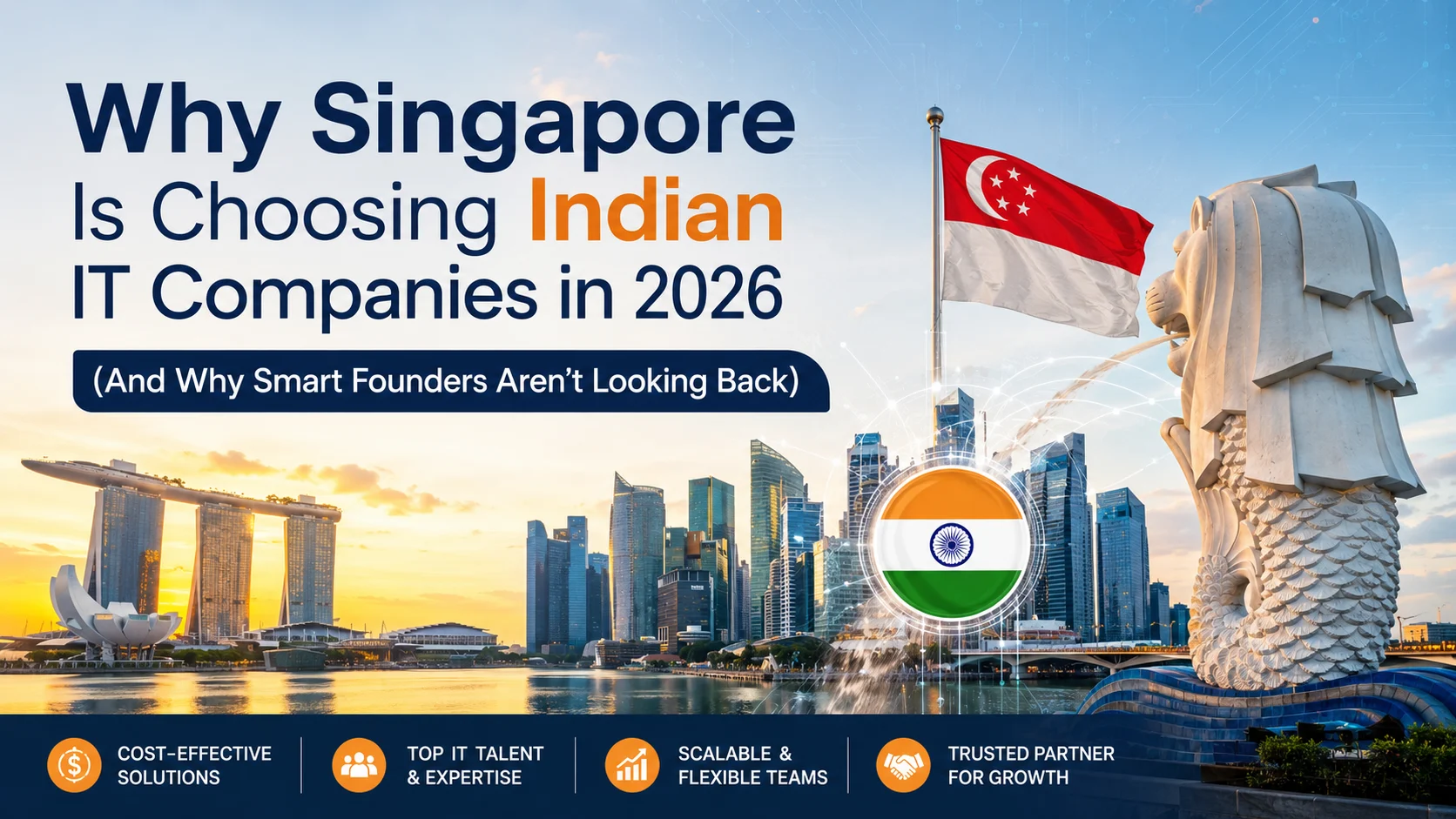
This isn't a you problem. It's a Singapore-wide structural one. And it's the single biggest reason a growing share of Singaporean founders, SMEs, and even enterprise teams are quietly building their technology with Indian IT companies instead of fighting over a thin local talent pool.
This isn't the old story of "outsource to India to save money." In 2026 the conversation has matured. Cost is now maybe the third reason on the list. Let's walk through what's actually driving the shift — and, just as importantly, how to do it without the horror stories you've heard.
First, the uncomfortable truth about Singapore's tech talent
Singapore is one of the best places on earth to run a business. It is not one of the easiest places to staff a software team. The country's digital economy has grown faster than its developer pipeline, and the result is a persistent, well-documented shortage of senior engineering talent. Demand for cloud, AI/ML, and full-stack skills consistently outruns local supply.
When supply is tight, three things follow: salaries climb, hiring timelines stretch from weeks into months, and retention becomes a bidding war. For a funded startup that needs to ship an MVP before the next raise — or an SME that just wants a working internal system — that math doesn't work.
Indian IT companies solve the supply problem directly. India produces one of the world's largest pools of engineering graduates every year and has spent three decades building the delivery infrastructure to serve global clients. The talent isn't cheaper-and-worse — that framing is a decade out of date. It's deep, available, and proven.
The 7 reasons Singapore is choosing Indian IT companies
1. The talent is there — at the seniority you actually need
The headline isn't volume; it's depth. Indian engineering teams routinely staff senior architects, AI/ML specialists, DevOps engineers, and full-stack leads who have shipped production systems for global brands. For a Singapore company, that means you can assemble a team in weeks that would take six months to hire locally — if you could hire it at all.
2. The cost difference funds your actual roadmap
Yes, the economics are favourable. An engineering hour in India typically costs a fraction of the fully-loaded cost of a Singapore hire once you add CPF, office space, and recruitment fees. But the smart way to read this isn't "I'll spend less." It's "I'll get more roadmap for the same budget." The same spend that buys you one local mid-level developer can buy a small, senior, multi-disciplinary Indian team. That's the real unlock.
3. The time zone is a feature, not a bug
Singapore (SGT) and India (IST) are just 2.5 hours apart. This is the quiet advantage almost nobody mentions. Unlike outsourcing to Eastern Europe or Latin America, where your working days barely overlap, an Indian team and a Singapore team share most of the working day. Stand-ups happen in real time. A bug raised in your morning is fixed before your evening. There's no "we'll hear back in 18 hours" lag that kills momentum.
4. English-first delivery removes the friction
India delivers software in English — documentation, stand-ups, code comments, contracts. For Singapore's English-business environment, that erases the communication tax that sinks so many offshore relationships. Requirements get understood the first time, not the third.
5. The compliance conversation has grown up
This is where 2026 looks very different from 2016. Serious Indian IT firms now build with PDPA (Singapore's Personal Data Protection Act) and GDPR front of mind, sign mutual NDAs at first contact, and follow ISO-aligned delivery processes. Data protection, IP transfer per milestone, and audit trails are standard asks that a mature partner answers without flinching. The "what about my data?" objection is real — and a good partner has a clear, documented answer for it.
6. The capability has moved up the value chain
India is no longer just a "coding shop." The strongest firms now deliver end-to-end product engineering: SaaS platforms, generative-AI features, mobile apps, cloud architecture, and digital transformation programs. Singapore companies aren't just sending over rote development tasks; they're co-building products. That shift — from staffing to partnership — is the most important change in the relationship.
7. The proof is already shipping
The most persuasive reason isn't an argument; it's a track record. Indian firms are already running live products for Singapore and APAC clients across fintech, healthcare, logistics, and fitness. When you can point at an app that's live in the App Store and Google Play, built for a real client, the "will this actually work?" question answers itself.
"But what about the risks?" — an honest section
No credible guide pretends offshore development is risk-free. Here's the straight talk, because pretending otherwise is exactly how people get burned.
- Quality varies enormously. India has world-class firms and bottom-of-the-barrel ones. The country isn't the variable — the partner is. Vet hard.
- Communication needs structure. A 2.5-hour overlap is an advantage only if you use it. Agree on a daily sync, a single point of contact, and a shared project board from day one.
- IP and data terms must be explicit. Insist on a written NDA, milestone-based IP transfer, and clarity on where data is stored and how PDPA/GDPR obligations are met. A serious partner offers this before you ask.
- Cheapest is rarely best. The lowest quote almost always carries the highest total cost — in rework, delays, and management overhead. Optimize for senior talent and clear process, not the smallest invoice.
Read that list as a buyer's checklist, not a deterrent. Every item is solvable by choosing the right partner.
How to choose the right Indian IT partner (a 6-point checklist)
- Live, verifiable products — can they show you something real in production, ideally for an APAC client?
- Senior team, not just headcount — who specifically works on your project, and what have they shipped?
- Clear PDPA/GDPR posture — do they have a documented answer on data handling and IP?
- Transparent, fixed-scope or milestone pricing — no vague "T&M and we'll see."
- Time-zone-aligned communication — a named point of contact and a real overlap window.
- A partnership mindset — do they push back and advise, or just take orders?
Where Datasoft Technologies fits
This is exactly the modelDatasoft Technologieswas built for. We're a Delhi-NCR-based software development company with a Dublin operational presence, delivering SaaS platforms, custom software, AI solutions, and mobile apps for clients across India, Singapore, the USA, UK, UAE, Australia, and Ireland — 150+ clients and 250+ projects, on ISO-aligned, GDPR- and PDPA-ready delivery.
For Singapore specifically, we tick every box on the checklist above:
- Real, live products for APAC clients — including PayLap Fitness, a full gym-management SaaS we built end-to-end (web dashboard, native iOS and Android apps, QR and face-recognition check-in) that's live in production today.
- Senior, multi-disciplinary teams in Laravel, React, React Native, Python, and AWS — assembled in weeks, not months.
- Singapore-friendly engagement — the 2.5-hour SGT/IST overlap, English-first delivery, mutual NDA at first contact, and IP transferred per milestone.
- A partnership, not a vendor relationship — clear timelines, transparent pricing, and senior input on what to build, not just how.
If you're a Singapore founder or business leader weighing up whether to keep fighting the local hiring market or build with a proven Indian partner, that's a conversation worth having.
Ready to ship faster without the Singapore hiring bottleneck? Book a free consultation with Datasoft Technologies → Or explore how we serve Singapore businesses: Software Development Company in Singapore
Frequently asked questions
Why do Singapore companies outsource IT services to India? The main driver is Singapore's shortage of available senior tech talent, combined with high local salaries and long hiring timelines. Indian IT companies offer deep, proven engineering talent, a favourable cost structure, a 2.5-hour time-zone overlap, English-first delivery, and increasingly mature PDPA/GDPR compliance — which together let Singapore businesses ship faster for less.
Is it safe to outsource software development from Singapore to India? Yes, when you choose carefully. Risks around quality, communication, and data protection are real but manageable: insist on live product references, a senior named team, a written NDA, milestone-based IP transfer, and a clear PDPA/GDPR data-handling policy. A mature partner like Datasoft Technologies provides these as standard.
How much can a Singapore company save by hiring developers in India? Savings vary by project, but Indian engineering costs are typically a fraction of the fully-loaded cost of an equivalent Singapore hire (once CPF, office, and recruitment are included). The bigger value is capacity: the same budget that funds one local mid-level developer can fund a small senior Indian team.
Does the time-zone difference between Singapore and India cause delays? No — it's actually an advantage. India (IST) is only 2.5 hours behind Singapore (SGT), so working days overlap substantially. This enables real-time stand-ups and same-day issue resolution, unlike outsourcing to regions with little or no working-hour overlap.
Which Indian IT company is best for Singapore startups and SMEs? Look for a partner with live products for APAC clients, senior multi-disciplinary teams, transparent pricing, and a documented PDPA/GDPR posture. Datasoft Technologies fits this profile, with 150+ clients across Singapore and beyond and live SaaS products such as PayLap Fitness.
Datasoft Technologies builds SaaS, custom software, AI, and mobile apps for Singapore and APAC businesses — with English-first delivery, SGT-aligned communication, and PDPA/GDPR-ready processes. Talk to our team or book a free consultation.