Artificial Intelligence models like large language models (LLMs) have transformed how businesses interact with data. However, one major limitation of traditional AI models is that they rely only on the data they were trained on.
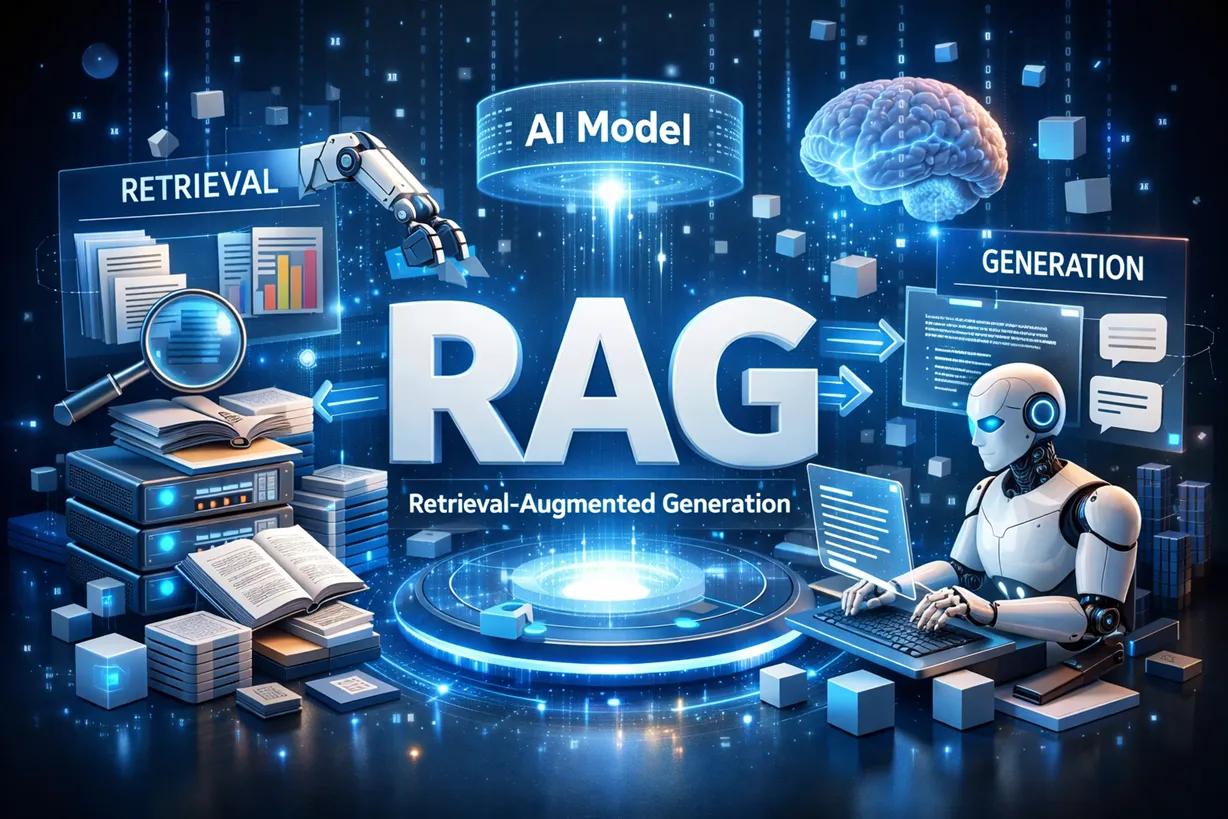
This is where RAG (Retrieval-Augmented Generation) comes in.
RAG is one of the most powerful advancements in modern AI architecture, helping models become more accurate, reliable, and context-aware.
Let’s understand it in simple terms.
What is RAG (Retrieval-Augmented Generation)?
Retrieval-Augmented Generation (RAG) is an AI framework that combines:
- Retrieval – Fetching relevant information from external sources
- Generation – Using a language model to generate a response based on that retrieved data
Instead of relying purely on pre-trained knowledge, a RAG system:
- Searches a database or knowledge base
- Retrieves the most relevant information
- Feeds that information into the AI model
- Generates a response grounded in real data
In simple words:
Traditional AI = Answers from memory
RAG-based AI = Answers from memory + real-time reference material
Why Traditional AI Models Have Limitations
Large language models are powerful, but they have constraints:
- They may generate outdated information
- They can hallucinate (produce incorrect answers confidently)
- They do not automatically access private company data
- Retraining them frequently is expensive
RAG solves many of these issues without retraining the entire model.
How RAG Works (Step-by-Step)
Here is the simplified workflow:
- User asks a question
- System searches a knowledge base (documents, PDFs, database, website, etc.)
- Relevant content is retrieved using semantic search
- Retrieved content is sent to the language model
- The model generates a contextual, accurate answer
This approach ensures that the AI response is based on verified information.
How RAG Strengthens AI Models
1. Reduces Hallucinations
One of the biggest challenges in AI is hallucination — when models generate incorrect information.
With RAG:
- The model answers based on retrieved facts
- Responses are grounded in actual documents
Result: More reliable outputs.
2. Enables Real-Time Knowledge Access
AI models are trained on past data. But businesses need updated information.
RAG allows:
- Integration with live databases
- Access to latest documents
- Updated policy references
Result: AI systems that stay current without retraining.
3. Improves Accuracy in Enterprise Use
Companies have private data like:
- Internal policies
- Technical documentation
- Customer records
- Product manuals
RAG systems connect AI to internal company knowledge bases securely.
Result: AI becomes a true enterprise assistant.
4. Cost-Effective Scaling
Retraining large AI models is expensive and time-consuming.
RAG eliminates the need to retrain models frequently.
Instead:
- Update the knowledge base
- Keep the model unchanged
- Let retrieval handle the new information
Result: Lower infrastructure cost and faster deployment.
5. Better Contextual Understanding
RAG systems use vector databases and semantic search to understand meaning, not just keywords.
This allows:
- More relevant document retrieval
- Context-aware responses
- Improved customer support automation
Result: Higher quality AI interactions.
Real-World Applications of RAG
Customer Support Automation
AI retrieves information from product manuals and FAQs to answer queries accurately.
Healthcare
RAG systems access medical research databases to provide evidence-based responses.
Legal Industry
AI retrieves case laws and legal documents before generating summaries.
IT & Tech Services
AI agents use RAG to access internal documentation and resolve technical tickets.
E-commerce
Product descriptions and inventory data are retrieved in real time to answer customer questions.
RAG vs Fine-Tuning
Many businesses ask: Should we fine-tune or use RAG?
Fine-tuning:
- Changes model weights
- Expensive
- Less flexible
- Requires large training datasets
RAG:
- Keeps model intact
- Connects to external knowledge
- More scalable
- Easier to update
In most enterprise scenarios, RAG is more practical and cost-efficient.
Why RAG is the Future of Enterprise AI
Modern businesses demand:
- Accurate responses
- Secure access to internal data
- Scalable AI systems
- Reduced operational costs
RAG provides a bridge between large language models and real-world business data.
It turns general AI into domain-specific intelligence without rebuilding the model.
Final Thoughts
Retrieval-Augmented Generation is not just an enhancement — it is a foundational shift in how AI systems are built.
By combining external knowledge retrieval with generative intelligence, RAG:
- Reduces hallucinations
- Improves accuracy
- Keeps AI systems updated
- Makes enterprise AI more practical
As industries move toward AI-driven decision-making, RAG will play a critical role in building trustworthy, scalable, and cost-effective AI solutions.