Approx. 9 min read · 2,100 words
The Decision SMEs Get Wrong Before They Even Start
Every few weeks, a founder or operations lead asks us a version of the same question: should we build a software team in-house, or hand the work to an outside partner? It sounds like a budget question. It usually isn't. The choice between an internal team and outsourced software development is really a question about how much product risk you can absorb, how clearly you can describe what you want, and how fast the thing needs to ship.
We run a development firm, so you'd expect us to push outsourcing every time. We don't. Roughly a third of the SMEs who reach out would be better off hiring one or two strong engineers and keeping the work close. Another chunk shouldn't spend nine months recruiting for a project that has to launch in four. The honest answer depends on details that pricing pages and sales decks tend to skip, and that's what this guide walks through: real cost ranges, the trade-offs on both sides, and a short decision framework you can apply this week.
What Outsourced Software Development Actually Costs
Start with the number everyone wants. In 2026, a mid-level full-stack developer in the US carries a base salary of roughly $110,000 to $150,000, and the loaded cost (benefits, payroll tax, equipment, software licences, recruiting fees) usually runs 1.25 to 1.4 times that figure. So one in-house engineer is a $140,000 to $210,000 yearly commitment before they ship a single feature. Public salary benchmarks such as the Stack Overflow Developer Survey are a useful regional sanity check when you're modelling this.
Outsourced rates look different because they're priced by the hour or by the sprint. The market ranges we see in 2026: senior developers at established US or UK agencies bill $120 to $200 an hour; nearshore teams in Latin America or Eastern Europe land around $50 to $90; offshore teams in India bill $25 to $55 for comparable seniority. Those gaps are real. But the hourly rate is the least useful number in the conversation. A $30-an-hour developer who needs three rounds of rework costs more, in money and in calendar time, than a $75-an-hour developer who ships it once.
How you're billed matters as much as the rate. Fixed-bid contracts push risk onto the vendor but punish any change of scope, which is brutal for an SME still figuring out the product. Time-and-materials is honest but needs oversight so the hours don't drift. A dedicated-team model, where you pay for a stable set of engineers month to month, sits in between and tends to fit SMEs whose outsourced software development extends past a single project. Pick the billing model before you negotiate the rate.
The cost that actually wrecks SME budgets is rarely the rate. It's coordination overhead: time-zone lag, spec clarification, review cycles, and the meetings that exist only because two teams don't share a hallway. A retail client of ours once tracked it and found close to nine hours a week of founder time went purely into vendor coordination. That's a part-time job nobody put in the budget. We've written before about what DevOps outsourcing actually costs SMEs, and the same pattern holds: the visible line item is small next to the cost of misaligned expectations.
In-House vs Outsourced: A Side-by-Side Comparison
Here's how the two models compare on the factors that genuinely move an SME's decision. Treat it as a starting grid, not a verdict, because the right weighting depends on your situation.
| Factor | In-House Team | Outsourced Partner |
|---|---|---|
| Time to productive work | 2 to 4 months (hiring plus onboarding) | 1 to 3 weeks |
| Annual cost per senior engineer | $160k to $220k loaded (US) | $55k to $170k, depending on region |
| Control over priorities | High, adjustable daily | Medium, via contract and rituals |
| Domain knowledge retention | Stays inside the company | Risk of walking out with the vendor |
| Scaling up or down | Slow, with hiring and severance cost | Fast, within contract terms |
| Quality oversight | You own the review process | Depends on the partner's standards |
| Best fit for | Core product, long-lived IP | Defined projects, capacity spikes, specialist skills |
Notice the table doesn't crown a winner. That's deliberate. For most SMEs, the row that decides it is the last one: is this software your product, or a tool that supports the real business?
Two rows deserve extra weight. Domain knowledge retention is the one SMEs underestimate most: when an outsourced team rolls off a project, the reasoning behind a hundred small decisions can leave with them unless you've insisted on documentation along the way. Scaling is the row where outsourced software development clearly wins. Hiring three engineers takes a quarter, and letting them go later carries real human and legal cost, while a partner can add or drop capacity inside a single billing cycle. If your workload is spiky, that flexibility on its own can justify the model.
Where In-House Quietly Wins
If software is your product rather than a supporting tool, the knowledge your engineers build up is the company. A logistics SME we advised in early 2025 had outsourced their core routing engine to three different vendors across four years. Each handoff lost context. By the time they finally hired internally, no single person understood why the system silently rejected certain address formats, and unpicking that took two engineers a full quarter. That's the in-house argument in one line: continuity compounds, and so does the cost of losing it.
In-house also wins when priorities shift week to week. Startups pivot. If your roadmap is a moving target, a salaried team sitting in the same standup adapts faster than a contracted team working from a statement of work that's already three revisions out of date. And for the developers themselves, an in-house environment usually means cleaner ownership: they see the production incidents, they feel the technical debt, and they have a reason to fix the root cause instead of patching to spec. That feedback loop is hard to replicate across a contract boundary.
Where Outsourcing Bites Back
Outsourcing has a failure mode that sales decks never mention: the demo trap. A vendor builds something that looks finished, the founder approves it on the strength of a smooth walkthrough, and the gaps surface in production. Last year we picked up a project from a 14-person retail startup whose previous vendor had shipped a checkout flow that passed every demo and then dropped roughly one order in twenty under real traffic, because payment webhooks were handled synchronously with no retry queue. The founder had no in-house engineer to catch it in review. That's the quiet cost of outsourced software development without technical oversight on your own side.
The truth is that outsourcing doesn't remove the need for engineering judgement on your team. It relocates it. You still need someone who can read a pull request, push back on a vague estimate, and tell whether "it's done" actually means done. SMEs that outsource well almost always keep one technical person in-house, even part-time or fractional, as the translation layer between business intent and delivered code. Skip that role and you're trusting a demo, which is exactly how the retail startup above ended up paying twice.
How SMEs Should Actually Decide
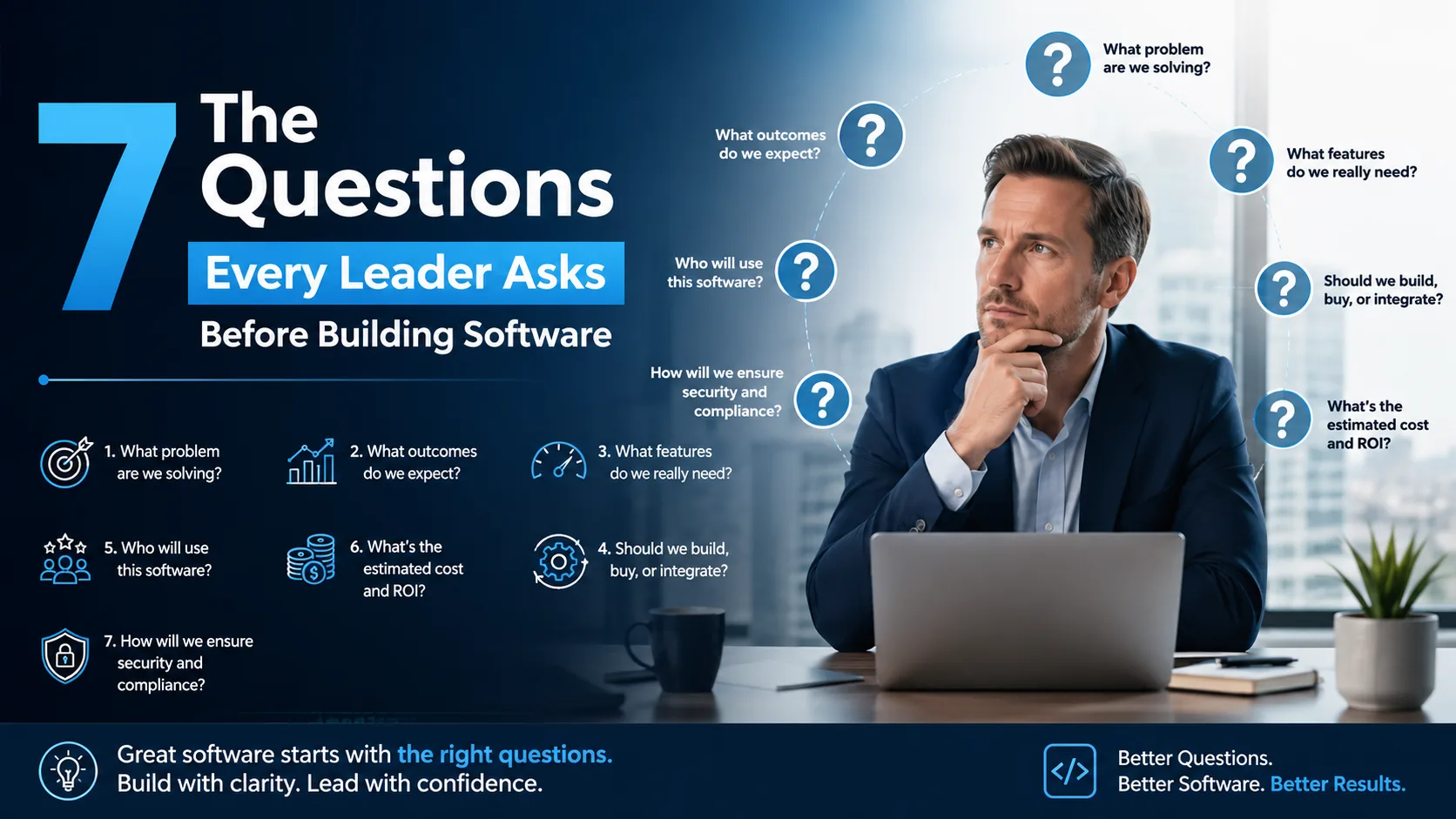
Put the spreadsheet down for a minute and answer four questions honestly.
- Is this software your product, or a tool that supports it? Product means lean in-house. A supporting tool means outsourcing is firmly on the table.
- Can you write a clear spec? Outsourced software development rewards teams that can describe what they want in writing. If the spec lives only inside a founder's head, an internal team will read that head far better than any contract can.
- What's your timeline? If it has to be live this quarter, hiring won't get you there in time. A partner can start next week.
- Do you have technical oversight? If nobody on your side can judge code quality, budget for a fractional CTO or pick a partner that builds architecture review into the engagement.
A few red flags should end a vendor conversation early. If a partner quotes a firm price before seeing a written scope, they're either padding heavily or planning to surprise you with change requests later. If they can't name the specific engineers who'll sit on your account, you may be a line item in a resourcing spreadsheet rather than a client. And if code ownership isn't spelled out in the contract, stop until it is. These checks take an afternoon and save you quarters.
The honest weighting changes by who's asking. For an SME owner, the deciding factor is usually total cost of ownership across three years, not the size of the first invoice. For a startup founder, it's speed and runway: outsourcing a first version so you can ship a SaaS product faster can buy the months you need to reach revenue or close a round. For an IT decision-maker, it's vendor risk and security posture, which means code ownership clauses, access controls, and exit terms matter more than the headline rate. And for the developer or tech lead asked to absorb an external team, it's interface quality: clean APIs, real documentation, and a review process that doesn't collapse the week before a deadline.
A middle path works for a surprising number of SMEs: a small internal core that owns architecture and review, plus an external team for delivery capacity. That's effectively what dedicated development teams give you, and it sidesteps the worst of both extremes. If you'd rather keep the build in-house but want senior input shaping it early, an independent IT consulting review at the start costs a fraction of what a rebuild costs later. For teams that have already decided to recruit, our notes on how to hire dedicated React developers without getting burned walk through the screening traps worth avoiding. At Datasoft Technologies, we work on both sides of this line, from custom application development through to staff augmentation, so the recommendation we give a client isn't quietly tied to selling one model over the other.
Frequently Asked Questions
Is outsourced software development cheaper than hiring in-house?
Often, but not always, and rarely for the reason people assume. The hourly rate is lower offshore, yet the bigger saving comes from not carrying a salaried team between projects. If you have steady, full-time work for two or more years, an in-house engineer can be the cheaper option across that horizon.
Can an SME outsource its core product safely?
Yes, provided you keep ownership of the code, the repositories, and the architectural decisions. The real risk isn't outsourcing the work; it's outsourcing the understanding. Keep at least one person on your side who can review and reason about what gets delivered.
How long does it take to hire a software developer in 2026?
For a strong mid-to-senior engineer, plan on two to four months from posting the role to a productive first month of work. Specialist skills such as ML engineering or application security typically take longer. An external partner can usually staff an equivalent project inside three weeks.
What's the biggest hidden cost of outsourcing?
Rework caused by unclear requirements. A vague brief produces software that's technically delivered but wrong, and correcting it after the fact costs more than the original build did. Invest in the specification before you invest in comparing hourly rates.
Should a startup outsource its MVP?
It's a reasonable choice when speed matters more than retained knowledge and the founding team can still actively steer the product. Plenty of startups outsource the first version, then bring engineering in-house once the product finds traction and the funding to support salaries.
Final Take
There's no universal answer here, and anyone who hands you one is selling something. In-house wins when software is the company and the roadmap moves fast. Outsourcing wins when the work is well-defined, the timeline is tight, or you need a skill you'd never hire full-time. Most SMEs land somewhere in between, run a small core team, and bring in outside capacity when the work spikes. Industry research points the same way: cost is only one reason companies outsource, and access to specialist skills and flexible capacity often matter more, a pattern reflected in Deloitte's outsourcing research.
If you want a straight recommendation for your specific situation instead of a generic pros-and-cons list, book a free 30-minute scoping call with one of our senior engineers. We'll look at your roadmap, timeline, and budget, and tell you honestly which model fits, even when the answer is "hire internally, don't outsource this one."