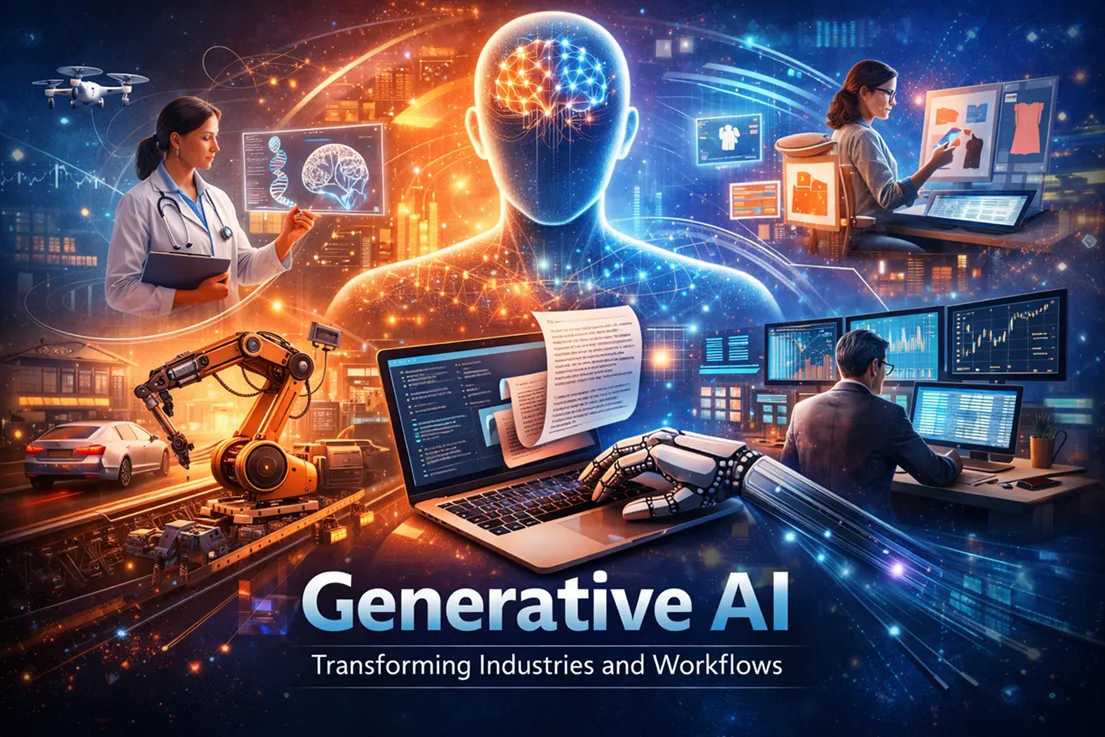
Artificial Intelligence has evolved far beyond basic automation. Today, a new category of AI is reshaping how businesses operate, innovate, and create value. This technology is known as Generative AI, and it is quickly becoming one of the most disruptive forces across industries.
Unlike traditional AI systems that focus mainly on analyzing data or making predictions, generative AI has the ability to create entirely new content and solutions. From writing marketing campaigns to designing products and assisting in drug discovery, generative AI is enabling machines to work alongside humans in ways that were unimaginable just a few years ago.
Businesses across the globe are now exploring how generative AI can transform their workflows, reduce operational costs, and accelerate innovation.
Understanding Generative AI
Generative AI refers to artificial intelligence systems capable of producing new outputs such as text, images, code, audio, and even complex designs. These systems learn patterns from massive datasets and then use that knowledge to generate new results based on user prompts.
For example, when someone asks an AI system to create a product description, write software code, or design a marketing campaign, the model generates content that follows the patterns it has learned from large volumes of training data.
This ability to simulate creativity is what makes generative AI fundamentally different from earlier AI technologies.
Modern generative AI models rely on deep learning architectures such as transformer-based neural networks and large language models. These technologies allow machines to understand context, language patterns, and complex relationships between data.
How Generative AI Works in Practice
At a fundamental level, generative AI operates through a structured learning and generation process.
First, the AI model is trained on extremely large datasets. These datasets may include books, websites, images, code repositories, and scientific research.
During training, the model learns patterns within the data. It begins to understand how words relate to each other, how images are structured, or how software code is written.
Once the model has learned these patterns, it can generate new outputs when given a prompt. The system predicts what information should come next based on the context of the request.
For example, if a marketing manager asks the AI to write a campaign for a new product, the system will generate a structured marketing message based on its understanding of successful marketing language.
The result is a tool that can assist humans in generating ideas, producing content, and solving complex problems much faster than traditional processes.
The Growing Impact of Generative AI Across Industries
Generative AI is not limited to one specific sector. Its ability to create new content and analyze massive datasets makes it useful across a wide range of industries. Companies are beginning to integrate this technology into their operations to improve efficiency and unlock new business opportunities.
Generative AI in Healthcare
Healthcare is one of the industries where generative AI is showing enormous potential.
Medical research often involves analyzing complex biological data and testing thousands of possible solutions. Generative AI can accelerate this process by generating potential drug molecules and predicting their effectiveness.
Pharmaceutical companies are using generative models to explore new treatments for diseases more quickly than traditional research methods.
Generative AI also helps doctors by generating medical documentation, summarizing patient histories, and assisting with diagnostic analysis based on medical imaging.
These capabilities allow healthcare professionals to spend more time focusing on patient care while reducing administrative workload.
Generative AI in Financial Services
Financial institutions deal with massive volumes of structured and unstructured data. Generative AI helps banks and financial organizations extract valuable insights from this data while improving operational efficiency.
One major application is fraud detection. AI systems can simulate fraudulent behavior patterns and help organizations detect suspicious transactions more effectively.
Generative AI is also being used to automate financial reporting, generate risk analysis summaries, and provide personalized financial advice to customers.
Customer service in banking is also evolving through AI-powered assistants that can handle complex queries and provide real-time support.
Generative AI in Manufacturing and Product Design
Manufacturing companies are increasingly adopting generative AI to improve product development and industrial design.
Traditional product design often requires engineers to create multiple prototypes before reaching the optimal solution. Generative AI can explore thousands of possible design variations based on specific performance requirements.
This process, known as generative design, allows engineers to create products that are lighter, stronger, and more efficient.
In addition, generative AI can analyze machine performance data to predict equipment failures and schedule maintenance before problems occur. This reduces downtime and improves overall production efficiency.
Generative AI in Marketing and Content Creation
Marketing is one of the fields where generative AI adoption has grown the fastest.
Businesses need to produce a constant stream of digital content, including blog posts, social media campaigns, product descriptions, and advertising creatives. Generative AI tools can assist marketers by generating high-quality content in a fraction of the time required by traditional processes.
Marketing teams are also using AI to generate personalized campaigns tailored to specific customer segments.
By analyzing consumer behavior and preferences, generative AI can help brands deliver more relevant messaging and improve engagement.
This allows companies to scale their marketing efforts while maintaining consistency and creativity.
Generative AI in Retail and E-Commerce
Retail companies are leveraging generative AI to enhance the customer shopping experience.
Online retailers can use AI to generate product descriptions, create personalized recommendations, and design marketing visuals automatically.
Generative AI also helps businesses forecast demand and optimize inventory management by analyzing historical purchasing patterns.
These insights allow retailers to improve operational efficiency and deliver a more personalized experience for customers.
Generative AI in Software Development
Software development is another field where generative AI is transforming workflows.
Developers can now use AI systems to generate code snippets, suggest improvements, and identify bugs in existing software.
This significantly speeds up the development process and allows engineers to focus on more complex problem-solving tasks.
Generative AI can also create documentation, write test cases, and assist with software architecture planning.
As a result, organizations are able to accelerate product development cycles and bring new digital products to market more quickly.
Challenges and Considerations
Despite its enormous potential, generative AI also presents several challenges that organizations must address.
One key concern is data privacy. Industries that deal with sensitive information must ensure that AI systems comply with strict security and regulatory requirements.
Another challenge is the possibility of incorrect outputs, sometimes referred to as AI hallucinations. Organizations must implement verification processes to ensure accuracy and reliability.
There are also ethical considerations related to bias in training data and the responsible use of AI-generated content.
Addressing these issues will be critical as generative AI continues to evolve.
The Future of Generative AI
The future of generative AI is likely to involve deeper integration into everyday business operations.
Companies may soon rely on AI systems to assist with strategic decision-making, product innovation, and automated customer experiences.
As the technology matures, generative AI will become an essential component of digital transformation strategies across industries.
Organizations that embrace this technology early will gain significant advantages in terms of productivity, innovation, and competitive positioning.
Final Thoughts
Generative AI represents a major shift in how technology supports human creativity and productivity. Instead of simply analyzing information, AI systems are now capable of generating ideas, solutions, and content that help businesses operate more efficiently.
Across industries—from healthcare and finance to manufacturing and marketing—generative AI is unlocking new possibilities and redefining traditional workflows.
As organizations continue to explore its capabilities, generative AI will play an increasingly central role in shaping the future of work and innovation.